<?xml version="1.0" encoding="UTF-8"?>
<?xml-stylesheet type="text/xsl" href="/stylesheets/feed.atom.xml" media="screen"?>
<feed xml:lang="en-US" xmlns="http://www.w3.org/2005/Atom">
  <id>tag:medieval.nd.edu,2005:/news-events/news</id>
  <link rel="alternate" type="text/html" href="https://medieval.nd.edu"/>
  <link rel="self" type="application/atom+xml" href="https://medieval.nd.edu/news-events/news.atom"/>
  <id>tag:medieval.nd.edu,2005:/latest</id>
  <title>Medieval Institute | News</title>
  <updated>2026-10-14T12:00:00-04:00</updated>
  <link rel="alternate" type="text/html" href="https://medieval.nd.edu/"/>
  <link rel="self" type="application/atom+xml" href="https://medieval.nd.edu//news-events/news.atom"/>
  <subtitle>The Medieval Institute is the oldest and largest center in the United States dedicated to the study and teaching of all aspects medieval culture.</subtitle>
  <entry>
    <id>tag:medieval.nd.edu,2005:News/186144</id>
    <published>2026-10-14T12:00:00-04:00</published>
    <updated>2026-10-14T13:35:25-04:00</updated>
    <link rel="alternate" type="text/html" href="https://medieval.nd.edu/news-events/news/dispatches-from-the-field-in-search-of-global-catholicisma-notre-dame-journey-through-the-archives-of-milan-and-rome/"/>
    <title>Dispatches from the Field: In Search of Global Catholicism—A Notre Dame Journey through the Archives of Milan and Rome</title>
    <summary type="text">
      <![CDATA[[gallery: 'gcri-dispatches-from-the-field-a-notre-dame-journey-through-the-archives-of-milan-and-rome' site: 'strategicframework.nd.edu'] Notes from Anna Katharina Rudolph, Managing Director of the Global Catholic Research Initiative, Research Affiliate with the Medieval Institute…]]>
    </summary>
    <content type="html">
      <![CDATA[<p><em><script src="https://medieval.nd.edu/javascripts/lb.js?v=2023-05-17" defer></script><ul id="gallery-1079" class="gallery-lb gallery-1079" data-count="5"><li><a href="https://strategicframework.nd.edu/assets/681755/fullsize/copy_of_img_7124.jpg" title="Entering the vault of the Biblioteca Ambrosiana—where two feet of reinforced steel safeguard centuries of irreplaceable manuscripts and rare texts." data-title="Entering the vault of the Biblioteca Ambrosiana—where two feet of reinforced steel safeguard centuries of irreplaceable manuscripts and rare texts."><img src="https://strategicframework.nd.edu/assets/681755/600x600/copy_of_img_7124.jpg" alt="A man in a white shirt and green pants talks with a woman in a blue patterned top and light blue cardigan." width="600" height="600" loading="lazy"></a></li><li><a href="https://strategicframework.nd.edu/assets/681756/fullsize/copy_of_img_7117.jpg" title="Mons. Francesco Braschi, Vice Prefetto of the Biblioteca Ambrosiana, tells the story of just one of many unique treasures housed in the vaults beneath the Ambrosiana." data-title="Mons. Francesco Braschi, Vice Prefetto of the Biblioteca Ambrosiana, tells the story of just one of many unique treasures housed in the vaults beneath the Ambrosiana."><img src="https://strategicframework.nd.edu/assets/681756/600x600/copy_of_img_7117.jpg" alt="Man with white beard gestures while showing an old book to a group of people in a room with shelves." width="600" height="600" loading="lazy"></a></li><li><a href="https://strategicframework.nd.edu/assets/682078/fullsize/copy_of_img_7122_1_.jpg" title="Don Federico Gallo, Direttore della Biblioteca Ambrosiana, displays a leaf from the Ilias Picta (Ambrosian Iliad). Dating to around 500 CE, it is the only surviving illuminated manuscript of the Iliad from antiquity and among the rarest classical treasures in the world." data-title="Don Federico Gallo, Direttore della Biblioteca Ambrosiana, displays a leaf from the Ilias Picta (Ambrosian Iliad). Dating to around 500 CE, it is the only surviving illuminated manuscript of the Iliad from antiquity and among the rarest classical treasures in the world."><img src="https://strategicframework.nd.edu/assets/682078/600x600/copy_of_img_7122_1_.jpg" alt="Man in black jacket points to illustrated manuscript on marbled table in archive." width="600" height="600" loading="lazy"></a></li><li><a href="https://strategicframework.nd.edu/assets/682077/fullsize/copy_of_img_7125_1_.jpg" title="Preserving the past, leaf by leaf. Conservators at the Biblioteca Ambrosiana restore a rare item from the collections." data-title="Preserving the past, leaf by leaf. Conservators at the Biblioteca Ambrosiana restore a rare item from the collections."><img src="https://strategicframework.nd.edu/assets/682077/600x600/copy_of_img_7125_1_.jpg" alt="A woman in a pink patterned dress and a man in a white lab coat examine a large book on a table." width="600" height="600" loading="lazy"></a></li><li><a href="https://strategicframework.nd.edu/assets/681752/fullsize/copy_of_sxgo0657jpg.jpg" title="The Notre Dame delegation meets with representatives of the Ambrosiana in the 17th-century Sala della Rosa—from left to right: Paolo Sirito, Silvia Dall'Olio, Prof. Andrea Canova, Erika Hosselkus, Mark Dehmlow, Margaret Meserve, Mons. Francesco Braschi, Anna Katharina Rudolph; photo taken by Don Federico Gallo.
" data-title="The Notre Dame delegation meets with representatives of the Ambrosiana in the 17th-century Sala della Rosa—from left to right: Paolo Sirito, Silvia Dall&#39;Olio, Prof. Andrea Canova, Erika Hosselkus, Mark Dehmlow, Margaret Meserve, Mons. Francesco Braschi, Anna Katharina Rudolph; photo taken by Don Federico Gallo.
"><img src="https://strategicframework.nd.edu/assets/681752/600x600/copy_of_sxgo0657jpg.jpg" alt="Seven people stand in front of a tall, ornate bookshelf filled with old books." width="600" height="600" loading="lazy"></a></li></ul><script>document.addEventListener("DOMContentLoaded", function(){var lightbox = new Lightbox({showCaptions: true,elements: document.querySelector(".gallery-1079").querySelectorAll("a")});});</script></em></p>
<p><em>Notes from Anna Katharina Rudolph, Managing Director of the Global Catholic Research Initiative, Research Affiliate with the Medieval Institute</em></p>
<p>Past collections, future possibilities: what a week in the libraries and archives of Milan and Rome revealed about the possibilities for research and partnership in Global Catholicism.</p>
<p>This summer, I had the unusual privilege of visiting some of Italy’s greatest libraries and archives with colleagues from the University of Notre Dame’s Hesburgh Libraries. Our purpose was prospective: to learn more about their collections, to meet the people who preserve and make them accessible, and to imagine how the Global Catholic Research Initiative and Hesburgh Libraries might work together to build deeper partnerships with these institutions in the years ahead.</p>
<p>For me, the trip also brought together two dimensions of my scholarly life. As a medieval historian, I am trained to find traces of the past in manuscripts, archives, objects, and the institutions that have preserved them across centuries. My work with GCRI has given me another vantage point from which to think about those same materials: how they might allow us to trace the movement of Catholic people, institutions, texts, objects, and ideas across geographical and cultural boundaries, and what scholarly infrastructure is needed to make those histories visible. Over several days in Milan and Rome, these perspectives continually converged in delightful and surprising ways.</p>
<figure class="image image-left"><img src="https://strategicframework.nd.edu/assets/681754/300x/copy_of_img_7138.jpg" alt="Woman smiles on a terrace with the Colosseum in the background." width="300" height="400">
<figcaption>Anna Katharina Rudolph</figcaption>
</figure>
<p>Our first stop was Milan’s Biblioteca Ambrosiana, where Notre Dame has maintained a relationship stretching back more than half a century. We were welcomed with extraordinary generosity by Don Federico Gallo, Mons. Marco Maria Navoni, Mons. Francesco Braschi, Fabio Cusimano, and Prof. Andrea Canova from the Università Cattolica del Sacro Cuore. Our guides introduced us not only to the Ambrosiana’s collections but also to the important work currently underway to preserve, catalog, and digitize them.</p>
<p>The Ambrosiana is the sort of place in which a historian could happily disappear for a very long time. One of the spaces I found most intriguing was a room filled with travel literature: shelves of books recording encounters with people and places far beyond Europe. Seen from the perspective of Global Catholicism, such a collection invites us to ask how knowledge traveled—who produced it, how it circulated, how encounters in one part of the world were described and understood in another—and also whose voices and experiences made their way into the written record in the first place.</p>
<p>Elsewhere in the Ambrosiana, the possibilities were quite literally over our heads: In a soaring room lined with books, our guides pointed upward, toward shelves beyond the narrow second-floor gallery that circled the walls. These contained the Ambrosiana’s vast collection of Borromeo correspondence. (Cardinal Federico Borromeo, archbishop of Milan, founded the Ambrosiana in 1607 as a center for scholarship and cultural exchange. The library also preserves materials connected with his famous relative, the reforming archbishop and future saint Charles Borromeo.) Some 50,000 letters have been microfilmed but remain uncatalogued and undigitized. The scale of the correspondence alone is extraordinary. And standing beneath it, I wondered what networks might become visible if these letters could be systematically cataloged and studied? What people, places, and exchanges might connect Milan to Catholic communities elsewhere?</p>
<p>This is where the possibilities of digitization become especially exciting. Digitizing a collection does far more than reproduce documents on a screen or allow a scholar to consult them from thousands of miles away. When paired with careful cataloging and metadata, it can make a collection searchable in entirely new ways, allowing scholars to trace correspondents, places, dates, and networks across tens of thousands of documents—and to see patterns that would be extraordinarily difficult to recognize one letter at a time. Digitization, in this sense, is not the end of the work but the beginning of new kinds of research. The promise of digitization lies in making visible connections that we do not yet know to look for.</p>
<p>That sense of possibility carried our little Notre Dame delegation into Rome. At the Archivio Storico di Propaganda Fide, Archivist Don Flavio Belluomini introduced us to the history and extraordinary scope of a collection comprising roughly three kilometers of documents generated by the Catholic Church’s missionary activities worldwide. The intense summer heat meant the archives themselves could not be opened safely during our visit, but our conversation offered a glimpse of the remarkable histories they contain.</p>
<p>For more than four centuries, the Church has looked to Rome not only as a center of Catholic governance, but as a point of connection among Catholic communities across the world. Established alongside the Congregation de Propaganda Fide in 1622 and today associated with the Dicastery for Evangelization, the archive preserves the documentary record of the Church’s engagement with peoples and cultures across Africa, Asia, Oceania, North America, and Europe. Its holdings trace the movement of missionaries, ideas, books, resources, and information across continents while also documenting the growth of local churches and the encounters that shaped Catholicism into a truly global tradition.</p>
<p>Yet the scale of the collection also makes visible one of the challenges facing scholars of Global Catholicism. Vast quantities of material remain to be inventoried, cataloged, preserved, and made more readily discoverable. Our conversations with Don Flavio, therefore, naturally turned toward what might come next: how graduate students and postdoctoral scholars might work with these collections, how improved inventories and digital tools might open them to new questions, and how institutions like GCRI might help connect the archive with scholars around the world.</p>
<p>One of the most memorable experiences of the week, though, took us much further back in time.</p>
<p>Just steps away from Notre Dame Rome, at the Basilica of San Clemente, Fr. Paul Lawlor, O.P., gave our group an extraordinary tour of the excavations beneath the present church. Rome was in the midst of a sweltering heatwave, and our descent beneath the twelfth-century basilica brought welcome relief as we passed into the deliciously cool air below. As we continued downward, first into the fourth-century Christian basilica and then farther still into the remains of first-century Rome, the city above seemed increasingly distant. And then there was the physical experience of being underground. The air smelled of damp earth and old stone—that wonderfully distinctive scent of ancientness that will be immediately familiar to anyone who cannot pass a crypt or catacomb on a European trip without disappearing down the stairs to investigate. An extraordinary lighting system pierced the gloom, revealing remarkable frescoes from the eighth through the eleventh centuries. Moss and tiny subterranean plants had taken root wherever thin shafts of sunlight found their way in, softening the excavated walls with unexpected flashes of green.</p>
<p>For a medieval historian, it was difficult not to be captivated. Here, centuries of religious and urban history survive not simply alongside one another but quite literally within the same physical space, bearing traces of how successive generations built upon, adapted, repurposed, preserved, and sometimes abandoned what they inherited. The experience of walking through San Clemente makes those processes unusually tangible: history is present in changes of masonry and floor level, in blocked passages and reused walls, but also in the trickles of water, sprouting vegetation, and shifting earth that have continued to reshape the site long after its spaces ceased to serve their original purposes. It is difficult to imagine a better place for a historian to be reminded that the past rarely disappears neatly.</p>
<p>Fr. Paul was a remarkably knowledgeable guide with a dazzling sense of humor who truly brought San Clemente’s layered history to life as he led us through its subterranean secrets. But as we emerged again into the present—and into the stifling Roman heat—our conversation turned toward the site’s future. San Clemente has been home to the Irish Dominicans since 1677, and its archives are being moved into a new climate-controlled space as part of the ongoing renovations. We left excited by the prospect of what that new space might eventually make possible: better conditions for the collections themselves, certainly, but also new opportunities for scholars and students to encounter and work with them.</p>
<p>Our week culminated at the Vatican Apostolic Library. Here, there was also a particularly meaningful Notre Dame connection. Stephen Metzger, Assistant in the Department of Manuscripts at the Vatican Library, is an alumnus of Notre Dame’s Medieval Institute. As a fellow medievalist, it was a pleasure to meet Stephen in Rome and to see where his own path from the Medieval Institute has taken him. Raffaella Vincenti, General Secretary of the Vatican Apostolic Library, and Don Mauro Mantovani, Prefect of the Vatican Apostolic Archive, welcomed our Notre Dame delegation with remarkable warmth. Our conversation moved easily between the medieval and the global: We talked about manuscripts and incunabula, diplomatics and digital scholarship, and also the Fondo Marega, a collection of some 14,000 documents concerning Christian communities in Japan from the seventeenth through nineteenth centuries.</p>
<p>That range felt fitting by the end of the week. Medieval manuscripts and Japanese Christian records might seem to belong to different scholarly worlds. So might a room of travel books in Milan, thousands of missionary documents at Propaganda Fide, an Irish Dominican archive, and 50,000 uncatalogued letters. Yet taken together, they point toward one of the things that excites me most about the study of Global Catholicism: the possibility of following people, texts, institutions, objects, and ideas across the geographical and chronological boundaries that so often organize our scholarship.</p>
<p>Just as important, however, were the people we met along the way. Archives and libraries do not preserve themselves. Again and again, we encountered librarians, archivists, clergy, and scholars who knew these collections intimately and were wonderfully generous in sharing that knowledge with us. They showed us not simply what their institutions possess, but their challenges, ambitions, and hopes for what those collections might make possible.</p>
<p>As Managing Director of GCRI, I spend a great deal of time considering what it will take to advance the study of Global Catholicism as a field, and how the University of Notre Dame might lead the charge. But I left Rome thinking about something larger: this work begins with relationships—between scholars and collections, between historians and the people who care for the sources we depend upon, and between institutions willing to imagine what they might accomplish together.</p>
<p>Global Catholicism is, after all, a history of connections. Building the field will require connections of its own. I am deeply grateful to everyone who opened their doors to us in Milan and Rome, and excited to see where these conversations might lead.</p>
<p class="attribution">Originally published by <span class="rel-author">Anna Katharina Rudolph</span> at <span class="rel-source"><a href="https://strategicframework.nd.edu/news/dispatches-from-the-field-in-search-of-global-catholicisma-notre-dame-journey-through-the-archives-of-milan-and-rome/">strategicframework.nd.edu</a></span> on <span class="rel-pubdate">October 08, 2026</span>.</p>]]>
    </content>
    <link rel="enclosure" type="image/jpeg" href="https://medieval.nd.edu/assets/682189/copy_of_img_7138.jpg" title="Woman in black jacket and floral dress smiles in front of the Colosseum."/>
    <author>
      <name>Anna Katharina Rudolph</name>
    </author>
  </entry>
  <entry>
    <id>tag:medieval.nd.edu,2005:News/185952</id>
    <published>2026-10-12T12:00:00-04:00</published>
    <updated>2026-10-09T11:16:53-04:00</updated>
    <link rel="alternate" type="text/html" href="https://medieval.nd.edu/news-events/news/new-from-our-research-blog-an-italian-itinerary-for-dante-lovers-florence-part-1/"/>
    <title>New from our Research Blog: "An Italian Itinerary for Dante Lovers: Florence (Part 1)"</title>
    <summary type="text">
      <![CDATA[After…]]>
    </summary>
    <content type="html">
      <![CDATA[<figure class="image image-right"><img src="https://medieval.nd.edu/assets/681258/2026picture1.jpg" alt="Panoramic view of Florence, Italy, featuring the Duomo and Ponte Vecchio with the Arno River." width="600" height="290"></figure>
<p><a href="https://sites.nd.edu/manuscript-studies/2025/08/20/an-italian-itinerary-for-understanding-dantes-divine-comedy-trajans-column-inrome/">After exploring Rome,</a> the next stop in Italy for a lover of Dante needs to be Florence, his birthplace and home until he was exiled for being a White Guelf in 1302. In Dante’s time, it was a flourishing cultural center at the intersection between ancient trade and pilgrim routes that connected the city to most of the known world. Pilgrims travelling from as far away as England might stop through Florence on their way to Rome, and to this day, the city is associated with a <a href="https://www.viefrancigene.org/en/about?scrlybrkr=a03368a7">modern pilgrimage route that traces the steps of St. Francis of Assisi to Rome.</a> This centrality not only fostered an immense cultural heritage, but it also positioned Florence at the center of a new European banking industry that made the florin (the coin of Florence) one of the standard currencies throughout Europe. To leave Florence, for Dante, must have felt like leaving not merely his world but the center of the known world itself.</p>
<p>Visitors to Florence today will find an abundance of Dante related things to do from understanding the history of the city at the <a href="http://www.museumsinflorence.com/musei/museum_firenze-com-era.html">Museo Storico Topografico Firenze Com’era</a><strong><em>,</em></strong> the origins of Dante the man at the <a href="https://www.museocasadidante.it/en/">Museo Casa di Dante</a>, and the <a href="https://www.santacroceopera.it/en/catalogue-of-works/dante-alighieri-cenotaph-ricci/">cenotaph of Dante in Santa Croce</a>. In the early twentieth century, a team of historians and Dante scholars identified important locations in Florence for understanding the <em>Commedia</em> and marked these locations with white Carrera marble plaques, each containing quotations from Dante. With the aid of <a href="https://www.feelflorence.it/en/experiences-itineraries/dantes-commemorative-plaques-florence#toc-dante-s-plaque-gianfigliazzi-palace">this website</a> or <a href="https://archive.org/details/inscriptionsfrom00rieduoft/page/86/mode/2up">Riedesser’s guidebook</a>, Dante lovers can follow the path of the many places and people mentioned by Dante.</p>
<p><strong><em>This is an excerpt from "An Italian Iternerary for Dante Lovers (Part 1)" by Lesley-Anne Dyer Williams (Ph.D. '12), Professor of Literature at Memoria College. <a href="https://sites.nd.edu/manuscript-studies/2026/09/16/an-italian-itinerary-for-dante-lovers-florence-part-1/">Read the full piece on our blog.</a></em></strong></p>]]>
    </content>
    <link rel="enclosure" type="image/jpeg" href="https://medieval.nd.edu/assets/681258/2026picture1.jpg" title="Panoramic view of Florence, Italy, featuring the Duomo and Ponte Vecchio with the Arno River."/>
    <author>
      <name>Medieval Institute</name>
    </author>
  </entry>
  <entry>
    <id>tag:medieval.nd.edu,2005:News/185778</id>
    <published>2026-10-09T12:00:00-04:00</published>
    <updated>2026-10-02T13:45:24-04:00</updated>
    <link rel="alternate" type="text/html" href="https://medieval.nd.edu/news-events/news/new-from-our-podcast-fair-fowl-perusing-medieval-recipe-collections-with-dr-eileen-morgan/"/>
    <title>New from our Podcast: "Fair Fowl: Perusing Medieval Recipe Collections with Dr. Eileen Morgan"</title>
    <summary type="text">
      <![CDATA[…]]>
    </summary>
    <content type="html">
      <![CDATA[<figure class="image image-right"><img src="https://medieval.nd.edu/assets/539415/300x/mitma_logo_blue.png" alt="Meeting in the Middle Ages podcast logo. Blue stylized arches with a microphone icon." width="300" height="471"></figure>
<p><a href="https://open.spotify.com/episode/1OodCBCfZGsnrWRTfh77hY" class="btn btn-more btn--more">Listen now</a></p>
<p>Skip the endless scroll of online recipe preambles and open up a medieval recipe collection this month with our guest, Dr. Eileen Morgan, Visiting Assistant Professor of Medieval History at Western Washington University. Come for the food, but stay for the stories about archival research, the medieval art of cooking, and how to display a peacock dish properly at your next feast. (If its mouth isn't flaming, you're not doing it right.)</p>]]>
    </content>
    <link rel="enclosure" type="image/jpeg" href="https://medieval.nd.edu/assets/633502/conductor_podcast_feature_image_1200x675.jpg" title="Blue logo with three stylized Gothic arches, the innermost containing a microphone, above the text &quot;MEETING in the MIDDLE AGES&quot;."/>
    <author>
      <name>Medieval Institute</name>
    </author>
  </entry>
  <entry>
    <id>tag:medieval.nd.edu,2005:News/185945</id>
    <published>2026-10-07T12:00:00-04:00</published>
    <updated>2026-10-02T23:40:39-04:00</updated>
    <link rel="alternate" type="text/html" href="https://medieval.nd.edu/news-events/news/lets-hear-it-for-good-news-celebrating-our-recent-achievements/"/>
    <title>Let's hear it for good news! Celebrating our recent achievements.</title>
    <summary type="text">
      <![CDATA[We recently asked you to share your good news from the summer with us, and we are delighted to share it with our whole community. Congratulations to all on their achievements! Did you know ...  You can submit   …]]>
    </summary>
    <content type="html">
      <![CDATA[<header></header>
<div class="entry-content">
<p>We recently asked you to share your good news from the summer with us, and we are delighted to share it with our whole community. Congratulations to all on their achievements!</p>
<em>Did you know ...</em>
<ul>
<li>You can <a href="https://medieval.nd.edu/news-events/submit-your-news/">submit your good news</a> throughout the year via our website.</li>
<li>We have a <a href="https://medieval.nd.edu/research/faculty-bookshelf/">faculty bookshelf</a> on our website and would be delighted for you to let us know when you have a new book out—just submit your information on the bookshelf site.</li>
</ul>
<hr>
<figure class="image image-right"><img src="https://medieval.nd.edu/assets/681277/300x/bloomer_2026_book.jpg" alt='Book cover for "Evoking the Dead" by W. Martin Bloomer, featuring Roman fresco details.' width="300" height="450"></figure>
<p>Professor Emeritus of Classics and MI Faculty Fellow <a href="https://classics.nd.edu/people/w-martin-bloomer/">W. Martin Bloomer</a> has published a new book, <a href="https://www.press.jhu.edu/books/title/12743/evoking-dead?srsltid=AU7gw4WXPzkpo4eI9bgi2wKi6eNeRDHTfYbKivefLoKvxowxo3hUwEMC"><em>Evoking the Dead: Roman Books of Memory</em></a> (Johns Hopkins University Press, 2026). During the turbulent transition from Republic to Empire, Romans became intensely preoccupied with their own past. In Evoking the Dead, W. Martin Bloomer examines how memory was constructed, organized, and put to work in this moment of political uncertainty—and how literature became one of its most powerful instruments.</p>
<hr>
<figure class="image image-right"><img src="https://medieval.nd.edu/assets/677098/300x/lamine6_front_cover.jpg" alt="A man with long dark hair wears a cross-topped crown and patterned robe, holding an open book. Faded Arabic script behind him." width="300" height="427"></figure>
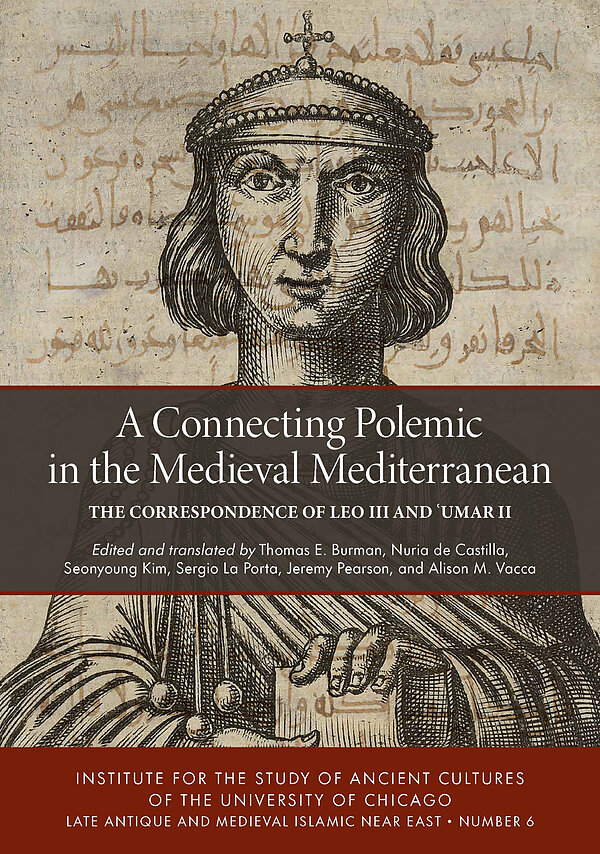
<p>Michael P. Grace Professor of Medieval Studies and past Robert M. Conway Director of the Medieval Institute, <strong><a href="https://history.nd.edu/people/thomas-burman/">Thomas E. Burman</a>, </strong>has a new co-edited book out, <a href="https://isac.uchicago.edu/publications/polemic-medieval-mediterranean-leo-iii-umar-ii"><em>A Connecting Polemic in the Medieval Mediterranean: The Correspondence of Leo III and ʿUmar II</em></a> (Chicago: Institute for the Study of Ancient Cultures, 2026). This book offers the first comprehensive edition and translation of all surviving versions—Latin, Armenian, Arabic, and Aljamiado—of the polemical correspondence attributed to the Byzantine emperor Leo III and the Umayyad caliph ʿUmar II.</p>
<hr>
<figure class="image image-right"><img src="https://medieval.nd.edu/assets/681202/300x/2026_megan_hall_talking_tudors.jpg" alt="Talking Tudors: Journey through 16th-century England with Natalie Grueninger. Podcast brand image of Tudor-style floral pattern on a yellow background." width="300" height="300"></figure>
<p>Our Associate Director and Term Assistant Teaching Professor <strong><a href="https://meganjhall.com">Megan J. Hall</a> </strong>was invited to record an episode of the <a href="https://talkingtudors.podbean.com/"><em>Talking Tudors </em>podcast</a>, hosted by Natalie Grueninger. The podcast can be <a href="https://talkingtudors.podbean.com/e/women-books-and-power-uncovering-medieval-female-literacy/">listened to here</a> (or on your favorite platform) or <a href="https://youtu.be/qpbKK5zdXdo?si=NDl9JjouaNZhE2oT">watched on YouTube</a>. She joined <em>Talking Tudors</em> to explore women's literacy and education in medieval England, tracing how reading and writing shifted from church-centered training to household and aristocratic learning between 1100–1300 and beyond. She discusses educational settings and curricula for girls and boys, the role of saints and literary models, and how modern research reshapes our assumptions about women's intellectual contributions.</p>
<hr>
<figure class="image image-right"><img src="https://medieval.nd.edu/assets/681197/300x/2026_cj_jones_book_jacket.jpeg" alt="Book cover for Fixing the Liturgy, showing a miniature of monks around a shrine." width="300" height="450"></figure>
<p>Professor of German Studies and our new Robert M. Conway Director of the Medieval Institute, <a href="https://medieval.nd.edu/about/director/"><strong>CJ Jones</strong></a>, received honorable mention in the <a href="https://cdn.ymaws.com/newchaucersociety.org/resource/resmgr/files/2026_congress/ncs_prize_announcement.pdf">2026 Biennial Publication prizes</a> of the New Chaucer Society for Best Monograph on a Topic dealing with Late-Medieval Literature and not author’s first monograph for their book <a href="https://www.pennpress.org/9781512825688/fixing-the-liturgy/"><em>Fixing the Liturgy: Friars, Sisters, and the Dominican Rite, </em><em>1256–1516</em></a> (University of Pennsylvania Press 2024). Jones’s monograph analyzes, through the study of the Dominican order, how liturgical changes reveal the ways medieval practitioners, including women, exercised forms of agency through ceremonies planned for their communities to experience and enact.</p>
<hr>
<figure class="image image-right"><img src="https://medieval.nd.edu/assets/680064/300x/81xysxpcvsl_sl1500_.jpg" alt="A historical street scene with crowds, buildings, and the American flag." width="300" height="450"></figure>
<p>Mary Lee Duda Emeritus Professor of Literature and MI Faculty Fellow <a href="https://english.nd.edu/people/tim-machan/"><strong>Tim William Machan</strong></a> has published a new book <em><a href="https://global.oup.com/academic/product/languages-legends-and-american-dreams-9780198979760?cc=us&amp;lang=en&amp;">Languages, Legends, and American Dreams: The Emergence of English in Multilingual America, 1750–1850</a></em> (Oxford University Press, 2026). <em>Languages, Legends, and American Dreams</em> concerns the development of an American language narrative in the formative years 1750–1850, from the United States' emergence out of disparate colonies, to its expansion across the North American continent, to the approach of a Civil War that threatened its very existence.</p>
<hr>
<figure class="image image-right"><img src="https://medieval.nd.edu/assets/679481/300x/doc_sep_16_2026_9_46_am.jpg" alt="The book cover shows two women in a richly decorated medieval room. One wears a dark blue, gold-patterned robe and white veil while holding an open book. The other wears a long red gown and faces her. Behind them are blue walls, arched windows, and colorful floral and gold decorations, resembling a medieval illuminated manuscript." width="300" height="455"></figure>
<p>Managing Director of the <a href="https://strategicframework.nd.edu/initiatives/global-catholic-research-initiative/">Global Catholic Research Initiative</a> and MI Research Affiliate <a href="https://strategicframework.nd.edu/people/anna-katharina-rudolph/"><strong>Anna Katharina Rudolph</strong></a> has published a new book, <em><a href="https://www.routledge.com/Rewriting-History-and-the-Myth-of-the-French-Nation-The-Hagiography-of-Radegund-of-Poitiers-from-Medieval-to-Modernity/Rudolph/p/book/9789048559152">Rewriting History and the Myth of the French Nation: The Hagiography of Radegund of Poitiers from Medieval to Modernity</a> </em>(Amsterdam Univeristy Press 2025, Routledge 2026). This multidisciplinary analysis of the cult of Radegund of Poitiers, from the sixth century to the twenty-first, illuminates the roles saints play at the intersection of gender and politics. No other medieval saint was so politically charged or had such an astonishing range of constructed personae. The many “Radegunds” encountered in this study—virgin, wife, mother, royalist, republican, colonizer—can all be interpreted as responses to contemporary political events, shifting spiritual trends, and changing attitudes towards women’s role in society or the Church.</p>
<hr>
<figure class="image image-right"><img src="https://medieval.nd.edu/assets/681201/300x/2026_dimitra_sikalidou_good_news.jpeg" alt="Two people walk through a grassy field with olive trees." width="300" height="300"></figure>
<p>This year's <a href="https://medieval.nd.edu/research/grants-fellowships/#Byzantine-fellowship">Stavros Niarchos Foundation (SNF) Byzantine Studies Postdoctoral Fellow</a>, <a href="https://medieval.nd.edu/people/visiting-scholars/"><strong>Dimitra Sikalidou</strong></a>, undertook an extensive fieldwork trip to Laconia, Greece, in preparation for her research on the religious landscape of the fortified settlement of Geraki. During her visit, she examined the material evidence at Geraki, while also visiting a number of other medieval/early modern sites throughout Laconia. An especially meaningful aspect of the fieldwork was the opportunity to speak with local residents and people connected to the sites. Their knowledge, memories, and personal connections to the monuments offered perspectives particularly valuable for a project interested not only in the transformation of monuments themselves, but also in the ways religious spaces have been experienced, used, and remembered by the communities around them.</p>
<hr>
<figure class="image image-right"><img src="https://medieval.nd.edu/assets/681198/300x/2026_deborah_tor_good_news.jpeg" alt="Two people smile in a long hall with tables and framed portraits on the wall." width="300" height="400"></figure>
<p>Associate Professor of History and MI Faculty Fellow<strong> <a href="https://history.nd.edu/people/deborah-tor/">Deborah Tor</a></strong> held a summer Franco Global Microresidency Fellowship at the Faculty of Asian and Middle Eastern Studies at the University of Oxford. She shared that apart from being wined, dined, and flooded with tea by colleagues at New College, All Souls, Brasenose, Pembroke, Lady Margaret Hall, St. John’s, and Wadham Colleges, she presented one of the chapters of her current monograph, participated in a conference on paganism in Arabia in Early Islamic Times, and planned future events with Oxford colleagues. The rest of the summer was spent completing the penultimate chapter of her book (which clocked in at 61 pages), reviewing two article manuscripts for <em>Studia Islamica</em> and <em>Journal of ʿAbbasid Studies</em>, and continuing to act as Medieval editor of the journal <em>Iranian Studies</em>.</p>
<hr>
<figure class="image image-right"><img src="https://medieval.nd.edu/assets/681199/300x/2026_jeff_wickes_book_jacket.webp" alt='Illustration of Cain striking Abel with a club, text "Verse Homilies on Cain and Abel".' width="300" height="427"></figure>
<p>Associate Professor of Theology and last year's Robert M. Conway Intermin Director of the Medieval Institute, <a href="https://theology.nd.edu/people/faculty/jeffrey-wickes/"><strong>Jeff Wickes</strong></a>, has a new book out, <em><a href="https://svspress.com/verse-homilies-on-cain-and-abel/">A Translation of Jacob of Serugh's Verse Homilies on Cain and Abel</a></em> (SVS Press, 2026). Jacob of Serugh, one of the foremost poets and theologians of the West Syrian tradition, composed hundreds of memre, or homilies in verse, on a multitude of topics. This translation from the Syriac original presents four of these verse homilies that are dedicated to the biblical story found in Genesis 4 of Cain’s murder of his brother Abel and his subsequent punishment by God.</p>
</div>]]>
    </content>
    <link rel="enclosure" type="image/jpeg" href="https://medieval.nd.edu/assets/458349/nd_congratulations.jpg" title="Gold starburst with the word &quot;congratulations&quot; laid over it"/>
    <author>
      <name>Medieval Institute</name>
    </author>
  </entry>
  <entry>
    <id>tag:medieval.nd.edu,2005:News/185915</id>
    <published>2026-10-05T12:00:00-04:00</published>
    <updated>2026-10-02T13:39:56-04:00</updated>
    <link rel="alternate" type="text/html" href="https://medieval.nd.edu/news-events/news/happy-graduate-student-appreciation-week/"/>
    <title>Happy Graduate Student Appreciation Week!</title>
    <summary type="text">
      <![CDATA[October 5–11 is Graduate…]]>
    </summary>
    <content type="html">
      <![CDATA[<figure class="image image-right"><img src="https://medieval.nd.edu/assets/633501/2025_10_06_conductor_feature_image_1200x675.jpg" alt="A person's hands form a heart shape in front of a grey shirt." width="600" height="338"></figure>
<p>October 5–11 is <a href="https://gradlife.nd.edu/programs-events/graduate-student-appreciation-week/">Graduate Student Appreciation Week</a>!</p>
<p>The Medieval Institute is proud to celebrate our wonderful graduate students and all that you bring to our community. We’re grateful for the time, energy, curiosity, and dedication you bring to your studies and to the MI. Your contributions make our community stronger!</p>
<p>We’ve got a few special surprises planned, so stay tuned! And don’t miss the full lineup of events, celebrations, food, freebies, and other fun happening across campus through the Graduate School and our campus partners.</p>
<p><a href="https://gradlife.nd.edu/programs-events/graduate-student-appreciation-week/" class="btn btn-more btn--more">Check out the list</a></p>]]>
    </content>
    <link rel="enclosure" type="image/jpeg" href="https://medieval.nd.edu/assets/633501/2025_10_06_conductor_feature_image_1200x675.jpg" title="A person's hands form a heart shape in front of a grey shirt."/>
    <author>
      <name>Medieval Institute</name>
    </author>
  </entry>
  <entry>
    <id>tag:medieval.nd.edu,2005:News/185338</id>
    <published>2026-09-30T12:00:00-04:00</published>
    <updated>2026-09-24T16:27:26-04:00</updated>
    <link rel="alternate" type="text/html" href="https://medieval.nd.edu/news-events/news/medieval-archaeology-site-in-someones-backyard-site-denmarks-largest-viking-age-silver-hoard/"/>
    <title>Routine Yard Work Reveals a Trove of Viking Silver—the Largest Treasure of Its Kind Ever Discovered in Denmark</title>
    <summary type="text">
      <![CDATA[The hoard includes bracelets and chains. North Jutland Museums…]]>
    </summary>
    <content type="html">
      <![CDATA[<figure class="image image-right"><img src="https://medieval.nd.edu/assets/680050/vikingesoelvskat_rebild_2026_1_2048x1365.jpeg" alt="Silver coins and ingots are scattered on a burgundy fabric, with chains and a brooch visible." width="600" height="400">
<figcaption>The hoard includes bracelets and chains. North Jutland Museums via <em>Smithsonian</em>.</figcaption>
</figure>
<p><em>From Smithsonian Magazine, by Sonja Anderson: </em></p>
<h2>Routine Yard Work Reveals a Trove of Viking Silver—the Largest Treasure of Its Kind Ever Discovered in Denmark</h2>
<p><strong>The collection includes coins, jewelry, silver bars and a tiny artifact shaped like Thor’s hammer. Experts say the roughly 700 items were buried during the tenth century.</strong></p>
<p>When a resident of northern Denmark started clearing their backyard, the plan was to install a new terrace. They expected a few hours of hard work. But after half an hour of digging, they came across something metallic: a trove of jewelry and coins.</p>
<p>Located in the municipality of Rebild, the backyard revealed the largest hoard of Viking silver ever discovered in Denmark. According to a statement from North Jutland Museums, the treasure includes roughly 700 artifacts and weighs more than 40 pounds. Experts think these items were buried in the tenth century.</p>
<p>“This is an exceptionally important Viking Age silver hoard,” archaeologist Torben Sarauw, head of cultural heritage at North Jutland Museums, tells the Art Newspaper’s Hadani Ditmars. “It provides a rare insight into the Viking Age silver economy, where silver functioned not only as coinage but also as weighed bullion used for trade, payments and storing wealth.”</p>
<p><em><strong>This is an excerpt. <a href="https://www.smithsonianmag.com/smart-news/routine-yard-work-reveals-a-trove-of-viking-silver-the-largest-treasure-of-its-kind-ever-discovered-in-denmark-180989456/">Read the full article</a>. </strong></em></p>]]>
    </content>
    <link rel="enclosure" type="image/jpeg" href="https://medieval.nd.edu/assets/680050/vikingesoelvskat_rebild_2026_1_2048x1365.jpeg" title="Silver coins and ingots are scattered on a burgundy fabric, with chains and a brooch visible."/>
    <author>
      <name>Medieval Institute</name>
    </author>
  </entry>
  <entry>
    <id>tag:medieval.nd.edu,2005:News/185698</id>
    <published>2026-09-28T12:00:00-04:00</published>
    <updated>2026-10-15T18:34:09-04:00</updated>
    <link rel="alternate" type="text/html" href="https://medieval.nd.edu/news-events/news/applications-open-for-2027-rome-archive-seminar/"/>
    <title>Applications open for 2027 Rome Archive Seminar</title>
    <summary type="text">
      <![CDATA[The Center for Italian Studies is pleased to announce that applications are now open for the 2027 Rome Archive Seminar.   This seminar is designed to introduce Ph.D. students from across the humanities to the unique primary sources available in Rome. Working …]]>
    </summary>
    <content type="html">
      <![CDATA[<div>
<p>The Center for Italian Studies is pleased to announce that applications are now open for the <strong>2027 Rome Archive Seminar</strong>.</p>
</div>
<div>
<p>This seminar is designed to introduce Ph.D. students from across the humanities to the unique primary sources available in Rome. Working hands-on with materials in the city’s archives and libraries, students will be exposed to the rich potential of a wide range of sources produced from the Middle Ages to the present. Seminar meetings will be held at the <a href="https://www.vaticanlibrary.va/" target="_blank" data-saferedirecturl="https://www.google.com/url?q=https://www.vaticanlibrary.va/&amp;source=gmail&amp;ust=1790101224902000&amp;usg=AOvVaw3cr_KktfKsNJrD-pTzeD6S" rel="noopener">Vatican Apostolic Library</a>, the <a href="https://www.cenl.org/library/the-central-national-library-of-rome/" data-saferedirecturl="https://www.google.com/url?q=http://www.bncrm.beniculturali.it/&amp;source=gmail&amp;ust=1790101224902000&amp;usg=AOvVaw1Yvaur6IktLft4lDwEge8N">Biblioteca Nazionale</a>, and the <a href="http://www.archiviodistatoroma.beniculturali.it/" target="_blank" data-saferedirecturl="https://www.google.com/url?q=http://www.archiviodistatoroma.beniculturali.it/&amp;source=gmail&amp;ust=1790101224902000&amp;usg=AOvVaw3i0VBl1hQVwfxiAl6uo3Nh" rel="noopener">Archivio di Stato</a>, and elsewhere. The seminar will also include a series of presentations by senior scholars who will discuss how they have collected and interpreted Roman primary sources in their own research.</p>
</div>
<div>
<p><strong>The dates for the 2027 Seminar are June 1 to June 25</strong>.</p>
</div>
<div>
<p>There are extraordinary and understudied materials in libraries and archives in the city for archeologists and classicists, art historians and historians, musicologists and students of theater and performance, historians of late antiquity, the Middle Ages, the early modern period and the world, specialists in the Near East and East Asia. The holdings of the Vatican Library alone include priceless manuscripts and documents from East Asia, the near East, and North Africa – as well as a vast collection of ancient, medieval and early modern texts in Greek and Latin, a unique resource for the history and literature of ancient Greece and Rome, of Christianity from its origins until recent times, of relations between Christians and Jews from antiquity onwards, and other subjects without number.</p>
</div>
<div>
<p>Previous seminar participants include students of art history, history, literature, political science, medieval studies, film studies, and musicology. Their areas of intellectual interest ranged from Byzantine art, papal humanism, hospitals, charity and pilgrimage, Persian embassies and the Chinese missions to art and science, fascist textile production, the history of sexuality, and politics and church in the postwar era. They have taken up primary sources like Anglo-Latin manuscripts, a Hebrew Arthurian legend, socioeconomic records of daily life, institutional records of church and state, art and material culture, films, and twentieth-century letters. Participants have come from Brown, Catholic University, Emory, Harvard, Northwestern, Princeton, Stanford, Syracuse, University of Chicago, University of Melbourne, University of Minnesota, University of Notre Dame, University of Texas Austin, University of Toronto, and others.</p>
</div>
<div>
<p>The professors in charge of the seminar this year are <a href="https://elts.ucla.edu/person/stefania-tutino/" target="_blank" data-saferedirecturl="https://www.google.com/url?q=https://elts.ucla.edu/person/stefania-tutino/&amp;source=gmail&amp;ust=1790101224902000&amp;usg=AOvVaw3y3KAlKQxwiF3JVXxabJ4N" rel="noopener">Stefania Tutino </a>(UCLA) and <a href="https://artdept.nd.edu/faculty/faculty-by-alpha/heather-minor/" target="_blank" data-saferedirecturl="https://www.google.com/url?q=https://artdept.nd.edu/faculty/faculty-by-alpha/heather-minor/&amp;source=gmail&amp;ust=1790101224902000&amp;usg=AOvVaw2dXN4AagFbO-BOk392K9xT" rel="noopener">Heather Minor</a> (Notre Dame). </p>
</div>
<div>
<p>This seminar is made possible by generous support from <a href="https://www.stanford.edu/" target="_blank" rel="noopener">Stanford University,</a> <a href="https://www.princeton.edu/" target="_self">Princeton University</a>, and the University of Notre Dame's <a href="https://italianstudies.nd.edu/" target="_self">Center for Italian Studies</a> and <a href="https://rome.nd.edu/" target="_self">Notre Dame Rome</a>.</p>
</div>
<div>
<h3>Qualifications</h3>
</div>
<div>
<p>We welcome applications from students from any discipline at any stage in their graduate education who have not done extensive research in Rome prior to the seminar. To be eligible to apply, you must be enrolled full-time in a Ph.D. program. The focus of your research need not be Rome but you should have an interest in developing that research through the use of primary sources located in the city. Each successful applicant will receive a stipend of up to $4,000 to defray travel costs, housing, and meals in Rome.</p>
<h3>Application Instructions</h3>
<div>
<p>Please send through Interfolio - <a href="https://apply.interfolio.com/193267">https://apply.interfolio.com/193267</a> - the following documents: a CV, a statement of interest, the name of one referee and the email address of the referee. Please confirm with your referee directly that an Interfolio link arrives to upload your letter of reference.</p>
<p>The application deadline is <strong>November 13</strong>. Review of applications will take place quickly after the deadline and applicants will be notified of the outcome no later than January.</p>
<p>Please direct any questions about the seminar to Prof. Minor at <a href="http://hhydemin@nd.edu/" target="_blank" data-saferedirecturl="https://www.google.com/url?q=http://hhydemin@nd.edu/&amp;source=gmail&amp;ust=1790101224902000&amp;usg=AOvVaw0oSmtOOwVYG_kk-GLCTxcg" rel="noopener">hhydemin@nd.edu</a>.</p>
</div>
</div>
<div> </div>
<p class="attribution">Originally published by <span class="rel-author">Demetrio Yocum</span> at <span class="rel-source"><a href="https://italianstudies.nd.edu/news-events/news/applications-open-for-2027-rome-archive-seminar/">italianstudies.nd.edu</a></span> on <span class="rel-pubdate">September 21, 2026</span>. Updated from source on October 15, 2026. </p>]]>
    </content>
    <link rel="enclosure" type="image/jpeg" href="https://medieval.nd.edu/assets/679625/with_dr_steve_metzger_in_the_apostolic_vatican_library_1_.jpg" title="Rome Seminar participants with Dr. Steve Metzger in the Apostolic Vatican Library"/>
    <author>
      <name>Demetrio Yocum</name>
    </author>
  </entry>
  <entry>
    <id>tag:medieval.nd.edu,2005:News/185626</id>
    <published>2026-09-25T12:00:00-04:00</published>
    <updated>2026-09-18T11:49:28-04:00</updated>
    <link rel="alternate" type="text/html" href="https://medieval.nd.edu/news-events/news/call-for-applications-italian-studies-library-research-award-at-notre-dame-3/"/>
    <title>Call for Applications: Italian Studies Library Research Award at Notre Dame</title>
    <summary type="text">
      <![CDATA[The Center for Italian Studies and Notre Dame Global are now accepting grant applications for the 2027-2028 Italian Studies Library Research Award.]]>
    </summary>
    <content type="html">
      <![CDATA[<figure class="image image-right"><img src="https://italianstudies.nd.edu/assets/635964/screenshot_2025_10_27_at_11556_pm.jpg" alt="Bird eye view of Notre Dame" width="600" height="395">
<figcaption><em>Bird eye view of Notre Dame</em></figcaption>
</figure>
<p>The <a href="https://italianstudies.nd.edu/" target="_blank" data-saferedirecturl="https://www.google.com/url?q=https://italianstudies.nd.edu/&amp;source=gmail&amp;ust=1729114804999000&amp;usg=AOvVaw0cq0HVMwHuZZVcU4LG7bHn" rel="noopener">Center for Italian Studies</a> and <a href="https://global.nd.edu/" target="_blank" data-saferedirecturl="https://www.google.com/url?q=https://global.nd.edu/&amp;source=gmail&amp;ust=1729114804999000&amp;usg=AOvVaw2uDL_8pRoI44_LDZubKabd" rel="noopener">Notre Dame Global</a> are now accepting grant applications for the 2027–2028 <a href="https://italianstudies.nd.edu/research/funding/the-italian-studies-library-research-award/" target="_blank" data-saferedirecturl="https://www.google.com/url?q=https://italianstudies.nd.edu/research/funding/the-italian-studies-library-research-award/&amp;source=gmail&amp;ust=1729114804999000&amp;usg=AOvVaw1YFaDv6GhKKZzo7O4L2V88" rel="noopener">Italian Studies Library Research Award</a>. The purpose of these grants is to assist scholars who travel to use the Italian Studies collections within Notre Dame’s Hesburgh Libraries.</p>
<p>The University of Notre Dame holds one of the premier collections of Italian literature in the United States. Of particular note are the <a href="https://rarebooks.library.nd.edu/collections/italian_lit/dante.html" target="_blank" data-saferedirecturl="https://www.google.com/url?q=https://rarebooks.library.nd.edu/collections/italian_lit/dante.html&amp;source=gmail&amp;ust=1729114804999000&amp;usg=AOvVaw3VUetYb0yYmapKMUGmbb2r" rel="noopener">Zahm Dante Collection</a>, which ranks among the most significant collections relating to Dante Alighieri in North America, the <a href="https://rarebooks.library.nd.edu/collections/italian_lit/primo_levi.html" target="_blank" data-saferedirecturl="https://www.google.com/url?q=https://rarebooks.library.nd.edu/collections/italian_lit/primo_levi.html&amp;source=gmail&amp;ust=1729114804999000&amp;usg=AOvVaw2TnujRmbR4bMCKTudACUn-" rel="noopener">Primo Levi Collection</a>, which includes first editions and translations of Levi’s works as well as first editions of Levi’s own efforts as a translator of both literary and non-literary works, and <a href="https://italianstudies.nd.edu/research/library-collections/christopher-g-wagstaff-film-collection/" target="_blank" data-saferedirecturl="https://www.google.com/url?q=https://italianstudies.nd.edu/research/library-collections/christopher-g-wagstaff-film-collection/&amp;source=gmail&amp;ust=1729114804999000&amp;usg=AOvVaw0L0BwEk46MOZe7VTuCQGCu" rel="noopener">the Christopher G. Wagstaff Italian Film collection</a>, which encompasses more than two thousand Italian films and television programs. The Hesburgh Libraries’ collections are also rich in Medieval and Renaissance Italian literature, represented through early imprints and translations, historical publications of textual criticism, and significant illustrated editions. Copies of many of the manuscripts and drawings of the <a href="https://italianstudies.nd.edu/research/collaborative-projects/#ambrosiana" target="_blank" data-saferedirecturl="https://www.google.com/url?q=https://italianstudies.nd.edu/research/collaborative-projects/%23ambrosiana&amp;source=gmail&amp;ust=1729114804999000&amp;usg=AOvVaw29TtS8c8ykOineG_7XeR4d" rel="noopener">Biblioteca Ambrosiana</a> in Milan may also be accessed via photographs and microfilm through the Notre Dame library.</p>
<p>Grants are awarded on a competitive basis to help defray the cost of travel and accommodation for a research visit of 1-3 weeks. The amount of the award (between $1,500 and $4,000) will be based on the length of the research visit and specific travel and accommodation expenses. The anticipated time-frame for visits to the Library within the award cycle is between <strong>April 2027 and June 2028</strong>. Applications can be submitted by <strong>January 31, 2027</strong>.</p>
<p><a href="https://italianstudies.nd.edu/funding/external-scholar-funding/information-for-applicants/" target="_blank" data-saferedirecturl="https://www.google.com/url?q=https://italianstudies.nd.edu/funding/external-scholar-funding/information-for-applicants/&amp;source=gmail&amp;ust=1729114804999000&amp;usg=AOvVaw3jAaxgcZma9vkaiwRH6GvR" rel="noopener">More information is available here</a>.</p>
<p class="attribution">Originally published by <span class="rel-author">Demetrio Yocum</span> at <span class="rel-source"><a href="https://italianstudies.nd.edu/news-events/news/call-for-applications-italian-studies-library-research-award-at-notre-dame-3/">italianstudies.nd.edu</a></span> on <span class="rel-pubdate">September 18, 2026</span>.</p>]]>
    </content>
    <link rel="enclosure" type="image/jpeg" href="https://medieval.nd.edu/assets/679134/screenshot_2025_10_27_at_11556_pm.jpg" title="Bird eye view of Notre Dame"/>
    <author>
      <name>Demetrio Yocum</name>
    </author>
  </entry>
  <entry>
    <id>tag:medieval.nd.edu,2005:News/185618</id>
    <published>2026-09-23T12:00:00-04:00</published>
    <updated>2026-09-18T11:58:24-04:00</updated>
    <link rel="alternate" type="text/html" href="https://medieval.nd.edu/news-events/news/new-from-the-podcast-adventures-in-bernards-affective-mysticism-with-dr-macie-sweet/"/>
    <title>New from the Podcast: "Adventures in Bernard's Affective Mysticism with Dr. Macie Sweet" </title>
    <summary type="text">
      <![CDATA[Listen Now  …]]>
    </summary>
    <content type="html">
      <![CDATA[<p><a href="https://open.spotify.com/episode/4AVJDBuKzqyymmaTvYFHTh" class="btn-more btn--more btn">Listen Now </a></p>
<figure class="image image-right"><img src="https://medieval.nd.edu/assets/539415/mitma_logo_blue.png" alt="Meeting in the Middle Ages podcast logo. Blue stylized arches with a microphone icon." width="600" height="941"></figure>
<p>Tired of the endless onslaught of addictive short form content on your social media feeds? Join us this month as we rediscover the simple power of our senses through the writings of Bernard of Clairvaux with Dr. Macie Sweet, Assistant Professor of Religious Studies at Loyola University New Orleans. Dr. Sweet provides insight into the exciting transitions of a scholar early in their career, shares about her writing process, and reminisces about her first foray into the exciting world of medieval mysticism.</p>
<p>Posted in: <a href="https://medieval.nd.edu/news-events/news/category/community-engagement/">Community Engagement </a></p>]]>
    </content>
    <link rel="enclosure" type="image/png" href="https://medieval.nd.edu/assets/539415/mitma_logo_blue.png" title="Meeting in the Middle Ages podcast logo. Blue stylized arches with a microphone icon."/>
    <author>
      <name>Medieval Institute</name>
    </author>
  </entry>
  <entry>
    <id>tag:medieval.nd.edu,2005:News/185265</id>
    <published>2026-09-21T12:00:00-04:00</published>
    <updated>2026-09-18T11:57:08-04:00</updated>
    <link rel="alternate" type="text/html" href="https://medieval.nd.edu/news-events/news/2027-submissions-open-for-the-medieval-academy-of-america-publication-prizes/"/>
    <title>Medieval Academy of America Publication Prizes: 2026 Competition </title>
    <summary type="text">
      <![CDATA[From the Medieval Academy of America   2026 Publication Prizes The Medieval Institute of America…]]>
    </summary>
    <content type="html">
      <![CDATA[<figure class="image image-right"><img src="https://medieval.nd.edu/assets/279504/maa_symbol_small_400x400.png" alt="Maa Symbol Small 400x400" width="400" height="400"></figure>
<p><em>From the Medieval Academy of America</em></p>
<p><strong> </strong></p>
<h2>2026 Publication Prizes</h2>
<p>The Medieval Institute of America invites applications for its Publication Prize program. The application deadline for submissions and dossiers is October 15, 2026. For more information about eligibility, submission, and deadlines, please see the MAA's <a href="https://www.medievalacademy.org/page/PublicationPrizes" title="MAA prize page"><span style="color: #0433ff;">prize</span></a> page.</p>
<p>The following prizes will be awarded at the<span style="color: #0433ff;"> <a href="https://www.medievalacademy.org/page/MAA2027"><span style="color: #0433ff;">2027 MAA Annual Meeting</span></a>.</span> The Program Committee invites proposals for papers on all topics and in all disciplines and periods of medieval studies. Any member of the Medieval Academy may submit a paper proposal and the Program Committee warmly welcomes proposals from graduate students. Special consideration can be given to individuals whose specialty would not normally involve membership in the Medieval Academy.<br><br></p>
<h2>Monograph Prizes</h2>
<ul>
<li>
<strong>John Nicholas Brown Priz</strong>e: Best First Monograph</li>
<li>
<strong>Byzantine Studies Prize</strong><strong>: </strong>Best Monograph in Byzantine Studies</li>
<li>
<strong>Karen Gould Prize:</strong> Best Medieval Art History Monograph</li>
<li>
<strong>Haskins Medal: </strong>Best Monograph in Medieval Studies</li>
<li>
<strong>Jerome Singerman Prize</strong><strong>:</strong> Best Second Monograph</li>
</ul>
<h2>Article Prizes</h2>
<ul>
<li>
<strong>Article Prize in Critical Race Studies</strong><strong>:</strong> Best Article in the field of Medieval Critical Race Studies</li>
<li>
<strong>Van Courtlandt Elliott Prize</strong>: Best Early-Career Article.</li>
</ul>
<h2>Other Formats</h2>
<ul>
<li>
<strong>Digital Humanities and Multimedia Studies Prize:</strong> Best DH Project</li>
<li>
<strong>Monica Green Prize: </strong>For an exceptional project (for example, a publication, exhibit, performance, or DH project) that shows the importance of studying the medieval past to understand the present.</li>
</ul>
<p><strong> </strong></p>
<p>More information regarding general policies and submission eligibility can be found at the <a href="https://www.medievalacademy.org/page/PublicationPrizes">Medieval Academy website</a>.</p>]]>
    </content>
    <link rel="enclosure" type="image/jpeg" href="https://medieval.nd.edu/assets/279506/maa_symbol_700p_web.jpg" title="The MAA symbol. A maroon outlined shield on a white background. Inside, a stylized sun with jagged rays surrounds a central circular design with five interconnected petal-like shapes."/>
    <author>
      <name>Medieval Institute</name>
    </author>
  </entry>
  <entry>
    <id>tag:medieval.nd.edu,2005:News/185335</id>
    <published>2026-09-16T12:00:00-04:00</published>
    <updated>2026-09-18T15:03:55-04:00</updated>
    <link rel="alternate" type="text/html" href="https://medieval.nd.edu/news-events/news/new-book-by-mi-professor-thomas-e-burman-a-connecting-polemic-in-the-medieval-mediterranean-the-correspondence-of-leo-iii-and-umar-iii/"/>
    <title>New Faculty Book: &lt;em&gt;A Connecting Polemic in the Medieval Mediterranean: The Correspondence of Leo III and Umar II&lt;/em&gt;," edited and translated by Thomas E. Burman et al.</title>
    <summary type="text">
      <![CDATA[]]>
    </summary>
    <content type="html">
      <![CDATA[<figure class="image image-right"><img src="https://medieval.nd.edu/assets/677098/lamine6_front_cover.jpg" alt="Book cover showing a man with long dark hair wears a cross-topped crown and patterned robe, holding an open book. Faded Arabic script behind him." width="600" height="854"></figure>
<p>Congratulations to MI Faculty Fellow and Michael P. Grace Professor of Medieval Studies <a href="https://medieval.nd.edu/faculty/thomas-e-burman/">Thomas E. Burman</a> on his recent book collaboration <a href="https://isac.uchicago.edu/publications/polemic-medieval-mediterranean-leo-iii-umar-ii"><em>A Connecting Polemic in the Medieval Mediterranean : The Correspondence of Leo III and Umar II</em>,</a> released by the University of Chicago.</p>
<p>From the publisher's website:</p>
<p>"This book offers the first comprehensive edition and translation of all surviving versions—Latin, Armenian, Arabic, and Aljamiado—of the polemical correspondence attributed to the Byzantine emperor Leo III and the Umayyad caliph ʿUmar II. Far from simple diplomatic communication, these letters form part of a centuries-long Christian–Muslim exchange, rooted in fictional authorship but widely circulated across the Mediterranean from the eighth to the sixteenth century. The book explores their multilingual transmission and textual fluidity, as well as the evolution of their arguments, especially regarding scriptural reliability and Christology, to demonstrate how diverse communities adapted the texts to local polemical contexts. It identifies three main textual groupings and traces recurring argumentative strands, many of which derive from specific Qurʾanic passages, suggesting their origins in an oral, cross-confessional polemical milieu. The correspondence not only reflects shared themes of religious disputation but also continuously imagines itself as one episode in a larger, unending dialogue between Christianity and Islam. By situating these texts within vibrant Mediterranean networks, the book provides crucial insights into the construction, adaptation, and transmission of polemical literature in the premodern world."</p>]]>
    </content>
    <link rel="enclosure" type="image/jpeg" href="https://medieval.nd.edu/assets/677098/lamine6_front_cover.jpg" title="A man with long dark hair wears a cross-topped crown and patterned robe, holding an open book. Faded Arabic script behind him."/>
    <author>
      <name>Medieval Institute</name>
    </author>
  </entry>
  <entry>
    <id>tag:medieval.nd.edu,2005:News/185432</id>
    <published>2026-09-14T12:00:00-04:00</published>
    <updated>2026-09-09T16:22:06-04:00</updated>
    <link rel="alternate" type="text/html" href="https://medieval.nd.edu/news-events/news/notre-dame-global-awards-four-development-grants-to-strengthen-research-collaborations-in-ireland/"/>
    <title>Notre Dame Global Awards Four Development Grants to Strengthen Research Collaborations in Ireland</title>
    <summary type="text">
      <![CDATA[Four diverse new projects spanning artificial intelligence, wireless communications, medieval studies, and contemporary Irish history have been awarded Notre Dame Global’s Ireland Research Development Grants,…]]>
    </summary>
    <content type="html">
      <![CDATA[<p>Four diverse new projects spanning artificial intelligence, wireless communications, medieval studies, and contemporary Irish history have been awarded <a href="https://global.nd.edu/research/grants-and-funding/ireland-research-development-grant/">Notre Dame Global’s Ireland Research Development Grants</a>, advancing collaborative research between faculty from the University of Notre Dame and leading institutions across Ireland.</p>
<p>Part of the Global Network Research Development Grants program, the Ireland grants support partnerships that leverage Notre Dame’s presence in Dublin to build lasting international collaborations. This year’s awards support faculty and postdoc mobility, workshops, and symposia that will lay the groundwork for future publications and externally funded research initiatives.</p>
<p>“These seed grants serve as a core mechanism to engage Notre Dame faculty and deepen institutional partnerships around the world,” said Eimear Clowry Delaney, the Michael J. Smurfit Director of <a href="https://dublin.nd.edu/">Notre Dame Dublin</a>. “The exceptional ambition of the Ireland grant awardees highlights the calibre of scholarship we are proud to champion.”</p>
<hr>
<h2>6G Partnership Visit for the ND Wireless Institute's Collaboration with Trinity College Dublin and the Tyndall National Institute</h2>
<figure class="image image-left"><img src="https://dublin.nd.edu/assets/677373/150x/headshot_circle_for_website_10_.webp" alt="Man with glasses smiles wearing a tan jacket over a plaid shirt." width="150" height="150">
<figcaption></figcaption>
</figure>
<p><a href="https://engineering.nd.edu/faculty/toros-arikan/">Toros Arikan</a>, assistant professor of <a href="https://ee.nd.edu/">electrical engineering</a> and <a href="https://wireless.nd.edu/">Notre Dame Wireless Institute</a> faculty fellow, was awarded a travel grant to explore new collaborations in next-generation wireless communications.</p>
<p>Arikan will be hosted by <a href="https://research.ucc.ie/en/persons/holger-claussen/">Holger Claussen</a>, professor of wireless communications at Trinity College Dublin and University College Cork and head of the wireless communications laboratory at the <a href="https://www.tyndall.ie/">Tyndall National Institute</a>, one of Ireland’s national labs and a leading European research centre specialising in both electronics and photonics.</p>
<p>The visit will focus on integrated sensing and communications technologies for emerging 6G networks, including applications such as intelligent transportation systems. A partnership would open pathways for future joint research proposals supported by European and international funding programs.</p>
<h2>Form, Image, Action: Reframing Women in Medieval Worlds</h2>
<figure class="image image-left"><img src="https://dublin.nd.edu/assets/677374/150x/headshot_circle_for_website_11_.webp" alt="Person with short dark hair, blue eyes, smiling, and wearing a light blue button-down shirt." width="150" height="150">
<figcaption></figcaption>
</figure>
<p><a href="https://medieval.nd.edu/about/director/">CJ Jones</a>, the Robert M. Conway Director of the <a href="https://medieval.nd.edu/">Medieval Institute</a> and professor of <a href="https://germanandslavic.nd.edu/">German studies</a>, will expand the work of the existing research group Form, Image, Action, which focuses on reframing depictions of women in medieval worlds by examining the demonstrable impact women left on political, cultural, and religious structures.</p>
<p>The Form, Image, Action network was founded by Megan Welton (Notre Dame PhD ’17), assistant professor of history at University College Dublin; Anna Siebach-Larsen (Notre Dame PhD ’17), director of the Rossell Hope Robbins Library at University of Rochester; and Emily Ward, lecturer in medieval Scottish history at University of Edinburgh.</p>
<p>The project, funded by the Ireland Research Development Grant, will support a publication workshop for early-career researchers hosted at Notre Dame Dublin in December 2026, short postdoctoral exchanges between Notre Dame and University College Dublin, and planning for a collaborative exhibition with Dublin’s <a href="https://chesterbeatty.ie/">Chester Beatty Library</a> reexamining the lives and influence of medieval women.</p>
<h2>Irish newspaper columnists as public intellectuals 1960–2000</h2>
<figure class="image image-left"><img src="https://dublin.nd.edu/assets/677372/150x/headshot_circle_for_website_9_.webp" alt="A man with curly brown hair and blue eyes wears a suit and blue tie." width="150" height="150"></figure>
<p><a href="https://history.nd.edu/people/rory-rapple/">Rory Rapple</a>, associate professor of <a href="http://history.nd.edu/">history</a> and <a href="https://irishstudies.nd.edu/">Keough-Naughton Institute for Irish Studies</a> faculty fellow, will partner with <a href="https://research.universityofgalway.ie/en/persons/daniel-carey">Daniel Carey</a>, established professor of English at the University of Galway and director of the <a href="https://www.ria.ie/">Royal Irish Academy</a>, on a symposium examining Irish newspaper columnists as public intellectuals from 1960 to 2000.</p>
<p>Hosted at Notre Dame Dublin’s O’Connell House in 2027, the gathering will bring together journalists, editors, and scholars to explore how newspaper columnists shaped Irish political, social, and cultural discourse. The symposium will serve as a foundation for a future National Endowment for the Humanities Collaborative Research proposal and a broader transatlantic research project.</p>
<h2>School for Scientific Artificial Intelligence at Notre Dame Dublin</h2>
<figure class="image image-left"><img src="https://dublin.nd.edu/assets/677375/150x/headshot_circle_for_website_12_.webp" alt="Headshot of a man with short brown hair and beard, wearing a white shirt and dark jacket." width="150" height="150"></figure>
<p><a href="https://engineering.nd.edu/faculty/brett-savoie/">Brett Savoie</a>, the Coyle Mission Collegiate Professor of <a href="https://cbe.nd.edu/">Chemical and Biomolecular Engineering</a> and director of the <a href="https://sai.nd.edu/">Scientific Artificial Intelligence Initiative</a>, will run the School for Scientific Artificial Intelligence at Notre Dame Dublin, a three-day convening that will connect Notre Dame researchers with colleagues from Irish universities.</p>
<p>The program will combine educational workshops, hands-on tutorials, and research planning sessions focused on applying artificial intelligence to challenges in the physical sciences and engineering. By bringing together faculty, postdoctoral researchers, and graduate students, the initiative aims to establish enduring research networks while positioning Notre Dame and Irish partners for future collaborative funding opportunities.</p>
<hr>
<p>The strength and diversity of these projects demonstrate the growing role of <a href="http://dublin.nd.edu/">Notre Dame Dublin</a> as a convener of scholarly exchange and a platform for developing research partnerships between the University of Notre Dame and Irish universities and cultural institutions. Each project positions Notre Dame researchers for larger collaborative grants from organizations such as the National Endowment for the Humanities, Research Ireland, Horizon Europe, the European Research Council, and other international funding agencies.</p>
<p>Through the Global Network Research Development Grants, Notre Dame Global continues to invest in faculty and postdoctoral mobility and scholarship with international partner institutions, reinforcing Notre Dame’s aim to become the leading global Catholic research university. Learn more about faculty funding opportunities by visiting the <a href="https://global.nd.edu/research/grants-and-funding/?">Notre Dame Global website.</a></p>
<p><em>Contact </em><em>Maggie Arriola Fagan, associate director for partnerships and engagement, Notre Dame Dublin, </em><em>marriola@nd.edu</em></p>
<p class="attribution">Originally published by <span class="rel-author">Maggie Arriola</span> at <span class="rel-source"><a href="https://dublin.nd.edu/news-stories/news/notre-dame-global-awards-four-development-grants-to-strengthen-research-collaborations-in-ireland/">dublin.nd.edu</a></span> on <span class="rel-pubdate">July 13, 2026</span>. Republished at <a href="https://medieval.nd.edu">medieval.nd.edu</a> on September 14, 2026. </p>]]>
    </content>
    <link rel="enclosure" type="image/webp" href="https://medieval.nd.edu/assets/677844/nd_admissions_event_sept_2026_ndd_events_web_hero_image_5_.webp" title="Hand in light blue shirt holds Notre Dame Research pen over handwritten notes."/>
    <author>
      <name>Maggie Arriola</name>
    </author>
  </entry>
  <entry>
    <id>tag:medieval.nd.edu,2005:News/185258</id>
    <published>2026-09-09T12:00:00-04:00</published>
    <updated>2026-09-02T15:13:58-04:00</updated>
    <link rel="alternate" type="text/html" href="https://medieval.nd.edu/news-events/news/new-from-the-podcast-bringing-the-medieval-to-mississippi-teaching-medieval-literature-in-the-american-south-with-dr-anne-crafton/"/>
    <title>New from the Podcast: "Bringing the Medieval to Mississippi: Teaching Medieval Literature in the American South with Dr. Anne Crafton"</title>
    <summary type="text">
      <![CDATA[Listen Now This month,…]]>
    </summary>
    <content type="html">
      <![CDATA[<figure class="image image-right"><img src="https://medieval.nd.edu/assets/539415/x400/mitma_logo_blue.png" alt="Meeting in the Middle Ages podcast logo. Blue stylized arches with a microphone icon."></figure>
<p><a href="https://open.spotify.com/episode/1FnehotwpWAFUw9eZmsyWy" class="btn">Listen Now</a></p>
<p>This month, Dr. Anne Elise Crafton returns to the podcast to update us on their first year as the Professor of Early Literature and Linguistics at Mississippi University for Women. We discuss how medieval studies changes based on context, the joys and woes of a new professor's first year teaching, and how Mississippians handle the finer points of Old English poetry translation.</p>]]>
    </content>
    <link rel="enclosure" type="image/jpeg" href="https://medieval.nd.edu/assets/633502/conductor_podcast_feature_image_1200x675.jpg" title="Blue logo with three stylized Gothic arches, the innermost containing a microphone, above the text &quot;MEETING in the MIDDLE AGES&quot;."/>
    <author>
      <name>Medieval Institute</name>
    </author>
  </entry>
  <entry>
    <id>tag:medieval.nd.edu,2005:News/185257</id>
    <published>2026-09-07T12:00:00-04:00</published>
    <updated>2026-09-18T15:05:38-04:00</updated>
    <link rel="alternate" type="text/html" href="https://medieval.nd.edu/news-events/news/latin-patriarchate-of-jerusalem-to-launch-academic-forum-in-partnership-with-notre-dame/"/>
    <title>Latin Patriarchate of Jerusalem to launch academic forum in partnership with Notre Dame </title>
    <summary type="text">
      <![CDATA[Daniel Schwake and Cardinal Pizzaballa during…]]>
    </summary>
    <content type="html">
      <![CDATA[<figure class="image image-right"><img src="https://jerusalem.nd.edu/assets/675538/450x/pr7.jpg" alt="At a conference table, Daniel Schwake holds a notebook. A cardinal in a red zucchetto listens intently, hands clasped." width="450" height="300">
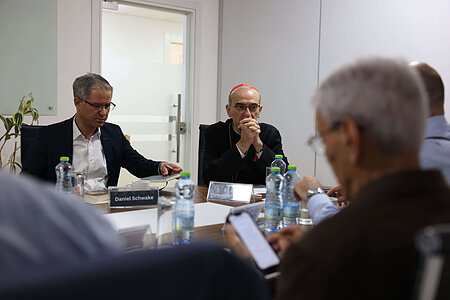
<figcaption>Daniel Schwake and Cardinal Pizzaballa during a workshop in Jerusalem</figcaption>
</figure>
<p>His Beatitude Cardinal Pierbattista Pizzaballa, Latin Patriarch of Jerusalem, will formally launch “Within Your Gates: The Forum for the Universal Vocation of Jerusalem” on September 7, 2026, in partnership with <a href="https://jerusalem.nd.edu/">Notre Dame Jerusalem</a>, the University of Notre Dame’s academic center in Jerusalem.</p>
<p>The Forum is an interdisciplinary research initiative that will bring together scholars and practitioners from different faith traditions and disciplines to engage with Jerusalem's universal mission and its significance for those who reside within the Holy Land and beyond.</p>
<p>Led by Notre Dame Jerusalem Director Daniel Schwake, Ph.D., the Forum grows out of more than three years of close cooperation with Cardinal Pizzaballa; Asher Kaufman, director of the<a href="https://kroc.nd.edu/"> Kroc Institute for International Peace Studies</a>; Clemens Sedmak, director of the<a href="https://nanovic.nd.edu/"> Nanovic Institute for European Studies</a>; Notre Dame Jerusalem; and other Notre Dame colleagues.</p>
<p>“One of our most important responsibilities as Christians is to discern God's call for us and to use our talents and gifts to serve Him and the world. This Forum creates a space for us to discern Jerusalem's unique vocation of bringing together peoples of many faiths to build bridges and to receive God's call to be peacemakers. I am proud that Notre Dame is working with Cardinal Pizzaballa to realize this vision of how discovering Jerusalem's vocation can lead us to knowledge of our own,” shared Rev. Gregory P. Haake, C.S.C., vice president for mission engagement and church affairs.</p>
<p>The Forum will produce applied interdisciplinary research rooted in Jerusalem's particular realities and oriented toward questions of daily life that resonate beyond the city and the surrounding region, exploring themes such as the theological significance of Jerusalem, the city's universal vocation, the language of conflict and reconciliation, and agency under conditions of constraint.</p>
<p>Cardinal Pizzaballa, who will chair the Forum’s Board of Promoters, will share his vision for the initiative at the September 7 launch event at the University’s Tantur campus. “The mission of earthly Jerusalem is to become the image and mirror of heavenly Jerusalem, a prophecy and promise of that universal reconciliation and peace which God desires for the whole human family,” he said. “It is to this mission that we must return.”</p>
<p>The September 7 launch event will include remarks from Cardinal Pizzaballa as well as scholars and practitioners who serve on the Forum’s Board of Promoters or the Advisory Committee.</p>
<p>For more information about the Forum, visit <a href="https://www.withinyourgates.org">Within Your Gates</a>. Questions about the launch event can be directed to <a href="mailto:jerusalem@nd.edu">jerusalem@nd.edu</a>.</p>
<figure class="image image-left"><img src="https://jerusalem.nd.edu/assets/675767/450x/pr5_2_.jpg" alt="Five smiling individuals, including a man in black clerical attire, stand by Kylemore Abbey, a lake, and green hills.">
<figcaption>Cardinal Pizzaballa at Kylemore Abbey with Notre Dame Kylemore Director Lisa Caulfield, Daniel Schwake, Gabriel Schwake (Vrije Universiteit Amsterdam), and Clemens Sedmak</figcaption>
</figure>
<figure class="image image-left"><img src="https://jerusalem.nd.edu/assets/675535/450x/pr2.jpg" alt="Cardinal Pizzaballa, in black clerical attire, speaks with a man in a burgundy shirt with crossed arms at a white table.">
<figcaption>Asher Kaufman sits alongside Cardinal Pizzaballa during a workshop in Cyprus.</figcaption>
</figure>
<hr>
<p class="attribution">Originally published by <span class="rel-author">Notre Dame Jerusalem</span> at <span class="rel-source"><a href="https://jerusalem.nd.edu/news-stories/news/latin-patriarchate-of-jerusalem-to-launch-academic-forum-in-partnership-with-notre-dame/">jerusalem.nd.edu</a></span> on <span class="rel-pubdate">September 01, 2026</span>. Republished at <a href="https://www.medieval.nd.edu">medieval.nd.edu</a> on September 07, 2026. </p>]]>
    </content>
    <link rel="enclosure" type="image/jpeg" href="https://medieval.nd.edu/assets/676849/pr5_2_.jpg" title="Five smiling people, including a woman in cream and a cleric, stand before Kylemore Abbey, a lake, and green hills."/>
    <author>
      <name>Notre Dame Jerusalem</name>
    </author>
  </entry>
  <entry>
    <id>tag:medieval.nd.edu,2005:News/185144</id>
    <published>2026-09-02T12:00:00-04:00</published>
    <updated>2026-08-28T17:16:38-04:00</updated>
    <link rel="alternate" type="text/html" href="https://medieval.nd.edu/news-events/news/five-questions-with-jacob-saliba/"/>
    <title>French Catholic thought across borders: Five questions with Jacob Saliba</title>
    <summary type="text">
      <![CDATA[Jacob Saliba joined Notre Dame in summer 2026 as a Cushwa Center postdoctoral research associate cosponsored by the University’s Global Catholic Research Initiative (GCRI). Trained as an intellectual…]]>
    </summary>
    <content type="html">
      <![CDATA[<p><em>Jacob Saliba joined Notre Dame in summer 2026 as a Cushwa Center postdoctoral research associate cosponsored by the University’s <a href="https://strategicframework.nd.edu/initiatives/global-catholic-research-initiative/">Global Catholic Research Initiative</a> (GCRI). Trained as an intellectual historian of modern Europe, Saliba’s research explores the influence of Catholic thought on 20th-century politics, culture, and philosophy, including questions of interreligious dialogue, secularism, and globalization. His current research focuses on the community bonds formed between Catholic, Jewish, Muslim, and secular intellectuals in France, Eastern Europe, North Africa, and the United States between World War I and World War II. Saliba earned his Ph.D. in history and his M.A. in political science from Boston College. He received the American Catholic Historical Association’s John Tracy Ellis Dissertation Award for 2026.</em></p>
<p><em>In July, Shane Ulbrich corresponded with Saliba about his graduate school experience and dissertation as well as the year ahead.</em><br><!-- [if !supportLineBreakNewLine]--><br><!--[endif]--></p>
<p><strong>Shane Ulbrich: Tell us about your graduate school years at Boston College. How did your research focus develop, and what were some key moments?</strong></p>
<p><strong>Jacob Saliba:</strong> I always felt fortunate to be able to pursue my graduate studies at a Catholic university where the very tradition that I analyzed in my research was made visible to me firsthand through encounters with trusted colleagues, scholars, and friends. So much, if not all, of our research is uplifted by the communities we are a part of. Boston College was no exception.</p>
<p>When I first arrived to pursue my M.A. in political science at BC, I quickly found myself interested not merely in the quantifiable relationship between religion and politics but in the people, institutions, and ideas of the past that could help us think about the deep stakes of the Catholic tradition today. Much of this was also influenced by the many scholars I engaged with while serving as primary editor of the <a href="https://www.jhiblog.org/"><em>Journal of the History of Ideas</em> Blog</a>.</p>
<p>Specifically, I might mention two important moments from my time in the Ph.D. program at BC. The first, grounded in the power of interdisciplinary inquiry, was Richard Kearney’s course on philosophy of religion. The impact was less from the readings (not that I wasn’t fascinated by the writings of Emmanuel Levinas and Paul Ricœur) than from the way in which these thinkers were narrated as part of a world bigger than themselves. As my dissertation grew over the years and the historian’s responsibility for narration became far more clear, I found myself more interested in those Catholic figures who were themselves acutely aware of the ethical and political stakes of their tradition in an increasingly secularized world—which is one reason why France and its legacy of <em>laïcité</em> made a large impression on me. The second defining moment occurred in the History Department’s seminar on modern Europe, which made it very clear to me that any compelling history of religion in France was necessarily tied to the tensions, dilemmas, and aspirations of the growing global order in the last century.<br><br></p>
<p><strong>SU: Tell us about your dissertation. You recently defended, in June—congratulations! And congratulations on receiving the John Tracy Ellis Dissertation Award. How did you arrive at the topic? </strong></p>
<p><strong>JS: </strong>Thank you! It’s an immense pleasure to reach this academic milestone, especially with an award from the ACHA. My topic, building on interdisciplinary and transnational research, came into focus, in part, through inspiration from books by Ed Baring, Sarah Shortall, Brenna Moore, Piotr Kosicki, and Stephen Schloesser, S.J., paving the way for me to ask new questions as well as instilling confidence in my adventures in archives. In order to realize the uniqueness of that historical moment wherein Catholics formed deep bonds of community with a variety of thinkers of other faith traditions and national backgrounds, I felt I needed to do a deep dive into the archival material, hoping to recover letters and unpublished manuscripts that may have been obscured over time. I confess that I wasn’t necessarily surprised to find dozens of these materials simply because I knew how my main thinkers—Gabriel Marcel, Gaston Fessard, S.J., Emmanuel Mounier, and Jacques Maritain—were themselves invested in experimentation, dialogue, and interpersonal exchange. Some of the century’s great thinkers in phenomenology, alterity, feminism, human rights, and political theology counted on those Catholic intellectuals as crucial dialogue partners.<br><br></p>
<p><strong>SU: What was your favorite chapter or two to write?</strong></p>
<p><strong>JS:</strong> If I had to pick a favorite chapter or two (which is tough because all of my chapters speak on different registers), I quite like my chapters on Mounier and feminism as well as on Maritain serving as president of the Free French University in New York while in exile. The former gave me an opportunity to explore a topic that remains very little-discussed, despite Mounier being a known name, and to situate Catholicism in relationship to some fascinating scholarship on gender emerging in the last decade. (It also allowed me to talk about Pierre Teilhard de Chardin’s concept of the “eternal feminine,” which also remains a bit under-explored.) The Maritain chapter was an equal favorite because I bridged, across thousands of miles, archival materials and fragments between the Maritain Center here at Notre Dame and the Bibliothèque nationale de France—always an exciting moment in a historian’s research! I’ll add that Maritain’s activism during World War II in the U.S., working directly with the Rockefeller Foundation and the New School for Social Research to save Jewish writers from Nazi-occupied Europe, powerfully demonstrated how the Catholic tradition is built on the <em>vita activa </em>as much as it is on the <em>vita contemplativa.<br><br></em></p>
<p><strong>SU: Tell us about your decision to apply for a fellowship with the Cushwa Center.</strong></p>
<p><strong>JS:</strong> My decision actually came quite easily. I was grateful to have received a travel grant from Cushwa a few years ago to consult Maritain’s archives at the Maritain Center (one of the great gems on campus). I felt that after the election of Pope Leo XIV, American Catholicism and its relationship to the rest of the world were cast in a new light. A lot of my own research on the 20th century, especially as World War II loomed and then erupted, investigates the globalizing effects of questions of human rights, exile, and migration—questions that feel extra timely today. If these were some conceptual reasons, I will also tie back to the Catholic liberal arts, more broadly, as another reason. Notre Dame’s commitment—like BC and many Catholic universities—to understanding the perennial demands of the human condition as both an intellectual and lived task resonated deeply with me. I am very excited to continue this work in the vibrant intellectual community at Notre Dame.<br><br></p>
<p><strong>SU: What are you looking forward to about the year ahead at Notre Dame?</strong></p>
<p><strong>JS:</strong> While working towards my doctorate, I published articles in the <a href="https://muse.jhu.edu/pub/16/article/952944/pdf"><em>Catholic Historical Review</em></a><em>, </em>the <a href="https://crossworks.holycross.edu/jgc/vol9/iss1/5/"><em>Journal of Global Catholicism</em></a>, and the <a href="https://doi.org/10.5195/jffp.2023.1038"><em>Journal of French and Francophone Philosophy</em></a>, as well as two French-to-English book translations: <a href="https://www.bloomsbury.com/us/authority-history-and-political-theology-9781350476349/"><em>Authority, History, and Political Theology: Collected Works and Correspondence of Alexandre Kojève and Gaston Fessard</em></a> (Bloomsbury, 2026) and <a href="https://wipfandstock.com/9798385230129/thinking-god-otherwise/"><em>Thinking God Otherwise: Entering into the Work of Emmanuel Falque</em></a> (Wipf and Stock, 2025). I mention these publications because while at Notre Dame I plan to continue to work across disciplines in order to explore new areas and scholarly conversations in which Catholicism can be understood for its expansive and ecumenical historical and normative spaces. To be able to do some of that as part of the newly established GCRI, under the direction of Kathleen Cummings, is a tremendous opportunity. The time is certainly ripe for thinking about the stakes of the global on all registers, and the GCRI is poised to help us rethink what those stakes are and why they matter. The <a href="https://maritain.nd.edu/">Maritain Center</a> likewise, building on the great legacy of Maritain as a world-renowned thinker, is just as meaningful a place for me and my work ahead.</p>
<p>While translations continue to be a point of interest for me, especially where language itself can serve as a bridge across borders and cultures, I have a couple of my own projects in progress. Firstly, the direct support of the Cushwa Center and David Lantigua as well as the people and resources of the GCRI and Maritain Center will help to refine my dissertation into a book manuscript. More broadly, I look forward to not only being of service to the missions of the Cushwa Center and GCRI but also to the many scholars and researchers throughout Notre Dame as this year’s exciting events and programming unfold!</p>
<p class="attribution">Originally published by <span class="rel-author">Shane Ulbrich</span> at <span class="rel-source"><a href="https://cushwa.nd.edu/news/five-questions-with-jacob-saliba/">cushwa.nd.edu</a></span> on <span class="rel-pubdate">August 28, 2026</span>. Republished at <a href="https://www.medieval.nd.edu">medieval.nd.edu</a> on September 02, 2026. </p>]]>
    </content>
    <link rel="enclosure" type="image/jpeg" href="https://medieval.nd.edu/assets/675830/saliba_hs_w_web.jpg" title="Smiling man with dark hair, wearing a dark blue suit jacket, a light blue checkered shirt, and a patterned blue tie."/>
    <author>
      <name>Shane Ulbrich</name>
    </author>
  </entry>
  <entry>
    <id>tag:medieval.nd.edu,2005:News/185143</id>
    <published>2026-08-31T12:00:00-04:00</published>
    <updated>2026-08-28T17:09:53-04:00</updated>
    <link rel="alternate" type="text/html" href="https://medieval.nd.edu/news-events/news/preserving-identity-ian-kuijt-honored-by-kyiv-university-for-ukrainian-heritage-work/"/>
    <title>Preserving Identity: Ian Kuijt Honored by Kyiv University for Ukrainian Heritage Work</title>
    <summary type="text">
      <![CDATA[In recognition of his work recording and documenting the wartime destruction of Ukrainian cultural sites, Notre Dame anthropology professor and Nanovic Faculty Fellow Ian Kuijt was awarded an honorary doctorate by the Taras Shevchenko National…]]>
    </summary>
    <content type="html">
      <![CDATA[<p>In recognition of his work recording and documenting the wartime destruction of Ukrainian cultural sites, Notre Dame anthropology professor and Nanovic Faculty Fellow <a href="https://anthropology.nd.edu/people/ian-kuijt/">Ian Kuijt</a> was awarded an honorary doctorate by the Taras Shevchenko National University of Kyiv (KNU) in spring 2026. Founded in 1834, KNU is one of the most prestigious institutions of higher learning in Ukraine, enrolling approximately 30,000 students. KNU bestows only one honorary doctorate each year.</p>
<p>This recognition highlights Kuijt’s 30 years of global heritage research and four years of intensive fieldwork in war-torn Ukraine. Partnering with Notre Dame professor and filmmaker William Donaruma, as well as faculty from Ukrainian Catholic University (UCU) and KNU’s Department of Archaeology and Museology, Kuijt began conducting field assessments following a late-2022 seminar co-organized with KNU and the Hv. Vovk Center for Paleoethnological Research. Together, the team documented damage to cultural, historical, and civic infrastructure across de-occupied territories in the Zhytomyr, Kyiv, and Chernihiv regions—ranging from historic churches and museums to libraries, schools, and hospitals.</p>
<figure class="image image-left"><img src="https://nanovic.nd.edu/assets/674582/300x/20230314_160331_1_.jpg" alt="Videographer captures a view of the historic Kyiv-Pechersk Lavra, one of Ukraine’s most iconic cultural and spiritual landmarks." width="300" height="424">
<figcaption>Professor Ian Kuijt captures a view of the historic Kyiv-Pechersk Lavra, one of Ukraine’s most iconic cultural and spiritual landmarks.</figcaption>
</figure>
<p>The award ceremony coincided with the KNU premiere of Kuijt and Donaruma’s latest documentary, <em>14 Litres of Ukrainian Blood</em> (2026). The making of this film, as well as their previous documentary, <em>Targeting Beauty</em> (2024), was supported by faculty grants issued by the Nanovic Institute. Filmed between 2023 and 2025, <em>14 Litres of Ukrainian Blood</em> moves beyond archaeology to capture personal accounts of war through interviews with UCU master’s students, military personnel, and clergy.</p>
<p>During the ceremony, the KNU rector commended Kuijt’s commitment to preserving Ukrainian heritage. He then presented Kuijt with <em>Day After the War,</em> a book project written collaboratively by KNU students and faculty which underscores the importance of memory, solidarity, and victory. The book echoes a core premise of Kuijt’s mission and work: recording sites of cultural heritage is about so much more than preserving the past; it is about securing the living identity that will shape Ukraine’s post-war reconstruction.</p>
<p><em>For further details on the conferral ceremony, view the<a href="https://knu.ua/news/13942"> official press release from Taras Shevchenko National University of Kyiv</a>.</em></p>
<p class="attribution">Originally published by <span class="rel-author">Grant Osborn and Roy Kimmey</span> at <span class="rel-source"><a href="https://nanovic.nd.edu/news/preserving-identity-ian-kuijt-honored-by-kyiv-university-for-ukrainian-heritage-work/">nanovic.nd.edu</a></span> on <span class="rel-pubdate">August 22, 2026</span>. Republished at <a href="https://www.medieval.nd.edu">medieval.nd.edu</a> on August 31, 2026. </p>]]>
    </content>
    <link rel="enclosure" type="image/jpeg" href="https://medieval.nd.edu/assets/675828/_dsc2014_1_.jpg" title="Two men shaking hands next to bookshelf"/>
    <author>
      <name>Grant Osborn and Roy Kimmey</name>
    </author>
  </entry>
  <entry>
    <id>tag:medieval.nd.edu,2005:News/184999</id>
    <published>2026-08-26T12:00:00-04:00</published>
    <updated>2026-08-21T14:23:29-04:00</updated>
    <link rel="alternate" type="text/html" href="https://medieval.nd.edu/news-events/news/new-from-the-podcast-written-in-copper-charters-kinship-and-medieval-south-asia-with-dr-mekhola-gomes/"/>
    <title>New from the Podcast: "Written in Copper: Charters, Kinship, and Medieval South Asia" with Dr. Mekhola Gomes</title>
    <summary type="text">
      <![CDATA[Listen Now This…]]>
    </summary>
    <content type="html">
      <![CDATA[<figure class="image image-right"><img src="https://medieval.nd.edu/assets/539415/x400/mitma_logo_blue.png" alt="Meeting in the Middle Ages podcast logo. Blue stylized arches with a microphone icon."></figure>
<p><a href="https://open.spotify.com/episode/3o0dATRl7oOOzitcyg4zwV" class="btn">Listen Now</a></p>
<div class="LVOcSBpw3iAaw0QqR6HF">This month, we chat with Dr. Mekhola Gomes, Assistant Professor of History and Asian Languages and Civilizations at Amherst College, about copper plate land grants, kinship, and what it means to study the Middle Ages outside of Europe. Dr. Gomes discusses her book project on how kinship and property shaped early medieval India between the third and eighth centuries, and reflects on how medieval studies is expanding its horizons. We also talk about the joys of slowly, painstakingly reading ancient inscriptions, teaching the Ramayana to undergraduates, and why understanding the past on its own terms still matters.</div>]]>
    </content>
    <link rel="enclosure" type="image/jpeg" href="https://medieval.nd.edu/assets/633502/conductor_podcast_feature_image_1200x675.jpg" title="Blue logo with three stylized Gothic arches, the innermost containing a microphone, above the text &quot;MEETING in the MIDDLE AGES&quot;."/>
    <author>
      <name>Medieval Institute</name>
    </author>
  </entry>
  <entry>
    <id>tag:medieval.nd.edu,2005:News/184998</id>
    <published>2026-08-24T12:00:00-04:00</published>
    <updated>2026-08-21T14:13:37-04:00</updated>
    <link rel="alternate" type="text/html" href="https://medieval.nd.edu/news-events/news/welcome-back-7/"/>
    <title>Welcome back!</title>
    <summary type="text">
      <![CDATA[We're delighted to have our faculty and students back for another terrific year…]]>
    </summary>
    <content type="html">
      <![CDATA[<figure class="image image-right"><img src="https://medieval.nd.edu/assets/674769/welcome_back.jpg" alt='Gold script "Welcome Back" against a cream brushstroke with a partial gold frame on a navy background.' width="600" height="450"></figure>
<p>We're delighted to have our faculty and students back for another terrific year together. Here are a few highlights to look forward to this fall!</p>
<h2>The 2026 Conway Lectures: "Religion and Law in the Medieval World"</h2>
<ul>
<li>Thursday, September 3, 5–6:30 p.m., followed by our <strong>fall opening reception</strong>
</li>
<li>Friday, September 4, 10 a.m.–2 p.m.</li>
<li>Speakers: <a href="https://profiles.laps.yorku.ca/profiles/hermanm/">Marc Herman</a> (York University), <a href="https://experts.exeter.ac.uk/43-rob-gleave">Robert Gleave</a> (University of Exeter), and <a href="https://www.fgcu.edu/directory/meichbauer">Melodie Eichbauer</a> (Florida Gulf Coast University)</li>
<li>All events will be held in the Medieval Institute (715 Hesburgh Library)</li>
<li><a href="https://medieval.nd.edu/news-events/annual-events/conway-lectures/">See all details on the lecture page</a></li>
</ul>
<h2>New Ph.D. Students</h2>
<ul>
<li><a href="https://medieval.nd.edu/people/graduate-students/drew-badgley/">Drew Badgley</a></li>
<li><a href="https://medieval.nd.edu/people/graduate-students/matthias-erbacher/">Matthias Erbacher</a></li>
<li>
<a href="https://medieval.nd.edu/people/graduate-students/rain-zhang/">Rain Zhang</a><a href="https://medieval.nd.edu/people/graduate-students/"></a>
</li>
</ul>
<h2>Visiting Scholars</h2>
<ul>
<li>Our 2026–27 <a href="https://medieval.nd.edu/research/grants-fellowships/#Mellon-fellowship" target="_blank" data-saferedirecturl="https://www.google.com/url?q=https://medieval.nd.edu/research/grants-fellowships/%23Mellon-fellowship&amp;source=gmail&amp;ust=1694131542062000&amp;usg=AOvVaw32KqDMpil-BbyBF03cAn0W" rel="noopener">Mellon Fellow</a> is <strong>Meghan Woolley</strong>, Assistant Professor of History at Idaho State University. Professor Woolley received her Ph.D. from Duke University. During her time at the institute, she will be researching and writing her book manuscript, <em>The Heart of Law: Friendship and Emotions in the Early Common Law</em>, which analyzes how a culture valuing emotional connection shaped the development and practice of the English common law in the twelfth and thirteenth centuries.</li>
<li>Our 2026–27 <a href="https://medieval.nd.edu/research/grants-fellowships/#Byzantine-fellowship">Byzantine Fellow</a>, <strong>Dimitra Sikalidou</strong>, received her Ph.D. from the Aristotle University of Thessaloniki. During her time at the institute, she will will investigate how religious life in the fortified settlement of Geraki (Laconia, Greece) evolved between 1400 and 1702 under conditions of political instability.</li>
<li>Our Public Humanities Fellow, <strong>Dr. Ashley Castelino</strong>, is continuing in his second year. He works closely with the institute’s staff, especially its director of undergraduate studies and engagement, on engagement efforts, and its associate director, on events and communications.</li>
<li>Our 2025–27 <a href="https://strategicframework.nd.edu/initiatives/provosts-postdoctoral-fellowship-program/">Provost's Postdoctoral Fellow</a> in Medieval Studies, Tzvi Schoenberg, is beginning his second year. He received his Ph.D. from the University of Chicago and is researching medieval Jewish Kabbalah and theology, examining analogical structures in 13th–4th century Kabbalah, focusing on linguistic and ontological models. </li>
<li>We are also hosting <strong>Pierre Courtain</strong> (Ph.D., Université catholique de Louvain and the Université de Nantes) for the year. During his time here, Dr. Courtain will study the works of Latin Dominican missionaries from the 13th century to shed light on their use of Arabic sources. His work is funded by the Belgian American Educational Foundation.</li>
<li><a href="https://medieval.nd.edu/people/visiting-scholars/">Learn more about our visiting scholars</a></li>
</ul>
<h2>Gameday Tailgate</h2>
<ul>
<li><time class="dtstart" datetime="2024-10-12T13:00-05:00">Saturday, September 19</time></li>
<li>Learn more on our <a href="https://medieval.nd.edu/community-engagement/">Community Engagement</a> page!</li>
</ul>]]>
    </content>
    <link rel="enclosure" type="image/jpeg" href="https://medieval.nd.edu/assets/674769/welcome_back.jpg" title="Gold script &quot;Welcome Back&quot; against a cream brushstroke with a partial gold frame on a navy background."/>
    <author>
      <name>Medieval Institute</name>
    </author>
  </entry>
  <entry>
    <id>tag:medieval.nd.edu,2005:News/184727</id>
    <published>2026-08-19T12:00:00-04:00</published>
    <updated>2026-08-18T17:42:57-04:00</updated>
    <link rel="alternate" type="text/html" href="https://medieval.nd.edu/news-events/news/announcing-the-notre-dame-medieval-mystery-cycle/"/>
    <title>Announcing the Notre Dame Medieval Mystery Cycle!</title>
    <summary type="text">
      <![CDATA[The Medieval Institute is excited to announce a staging of the Notre Dame Medieval Mystery Cycle, a partner performance of the 2027 Notre Dame Arts Biennial and…]]>
    </summary>
    <content type="html">
      <![CDATA[<p>The Medieval Institute is excited to announce a staging of the <a href="https://artsbiennial.nd.edu/art-and-artists/the-notre-dame-medieval-mystery-cycle/">Notre Dame Medieval Mystery Cycle</a>, a partner performance of the 2027 <a href="https://artsbiennial.nd.edu/">Notre Dame Arts Biennial</a> and supported with funding from the Notre Dame Arts Initiative.</p>
<figure class="image image-right"><img src="https://medieval.nd.edu/assets/673350/bodleian_library_ms_bodl_264_00064_fol_21v.jpg" alt="Illustration from a medieval manuscript: A lute player leads a line of people, three with deer, rabbit, and donkey heads, holding hands. A taller man with a club observes." width="600" height="233">
<figcaption>University of Oxford, Bodleian Library, MS. Bodl. 264, fol. 21v (CC BY-NC 4.0)</figcaption>
</figure>
<p>Mystery plays were a popular form of publicly-staged drama in the Middle Ages, involving town guilds and other groups across Europe acting out cycles of biblical narratives, from Creation to Last Judgement and everything in between. These plays were wonderfully dramatic, deeply contemplative, and at times very funny, with witty dialogue and physical comedy making them entertaining and meaningful to people of all ages and backgrounds.</p>
<figure class="image image-left"><img src="https://medieval.nd.edu/assets/616985/150x/ashley_castelino_web.jpg" alt="Headshot of a man with short dark hair, smiling, wearing a black and white patterned blazer over a dark turtleneck sweater, and a pendant necklace.  A stone archway is visible in the background." width="150" height="206">
<figcaption>Ashley Castelino</figcaption>
</figure>
<p>Under the guidance of our Public Humanities Postdoctoral Fellow, <a href="https://medieval.nd.edu/people/visiting-scholars/">Ashley Castelino</a>, the Medieval Institute will be bringing this tradition to the modern day as Notre Dame stages its own mystery cycle. "With its unique character as a Catholic university and its exceptionally diverse talents across the arts, Notre Dame is the perfect place for a fresh reimagining of the medieval mystery plays," says Castelino. "I can't wait to see how our students and wider community interpret and respond to this incredibly rich tradition!"</p>
<p>The Notre Dame Medieval Mystery Cycle will be staged over the course of an afternoon on April 10, 2027, on the Hesburgh Library Lawn. The performance will be free and open to all. Ahead of the performance, we are honored to host <a href="https://www.utoledo.edu/jhc/about/faculty/christina-fitzgerald/">Professor Christina Fitzgerald</a> (University of Toledo) for a guest lecture on January 29, 2027. An expert on medieval drama, Prof. Fitzgerald will be offering some fascinating context to participants and the public on the origins of this tradition and the importance of drama, play, and game in medieval English communities.</p>
<p>An official call for participants (actors, writers, musicians, costume designers, and more!) will open soon, but if you would like to find out how to get involved in the meantime, please reach out to Ashley Castelino at <a href="mailto:acasteli@nd.edu">acasteli@nd.edu.</a></p>
<p>For more on the Notre Dame Arts Biennial and its other exciting programming, see <a href="https://artsbiennial.nd.edu/">the Biennial website</a> and <a href="https://news.nd.edu/news/notre-dame-announces-inaugural-arts-biennial-featuring-prominent-artists-from-around-the-world/">this announcement from Notre Dame News</a>.</p>]]>
    </content>
    <link rel="enclosure" type="image/jpeg" href="https://medieval.nd.edu/assets/673350/bodleian_library_ms_bodl_264_00064_fol_21v.jpg" title="Illustration from a medieval manuscript: A lute player leads a line of people, three with deer, rabbit, and donkey heads, holding hands. A taller man with a club observes."/>
    <author>
      <name>Ashley Castelino</name>
    </author>
  </entry>
  <entry>
    <id>tag:medieval.nd.edu,2005:News/184707</id>
    <published>2026-08-17T08:00:00-04:00</published>
    <updated>2026-08-14T16:23:51-04:00</updated>
    <link rel="alternate" type="text/html" href="https://medieval.nd.edu/news-events/news/an-interview-with-cj-jones-the-new-robert-m-conway-director-of-the-medieval-institute/"/>
    <title>An Interview with CJ Jones, the New Robert M. Conway Director of the Medieval Institute</title>
    <summary type="text">
      <![CDATA[…]]>
    </summary>
    <content type="html">
      <![CDATA[<figure class="image image-right"><img src="https://medieval.nd.edu/assets/606387/400x/jones_cj_profile_no_teethjpg.jpg" alt="Headshot of a person with short brown hair, multiple ear piercings, and a light blue collared shirt against a gray background. They have blue eyes and offer a slight smile." width="400" height="400"></figure>
<p>CJ Jones joined Notre Dame and became a Faculty Fellow of the Medieval Institute in 2012 and was appointed Robert M. Conway Director in 2025. Their vision for the Medieval Institute includes enhanced student experiences, international collaboration, and continued support for interdisciplinary research.</p>
<p>Professor Jones earned a Ph.D. in Comparative Literature and Literary Theory from the University of Pennsylvania and holds an appointment as Professor of German Studies. Their interdisciplinary research draws together history, literature, music, liturgy, and manuscript studies to explore how religious women negotiated gendered and religious structures of authority. Their work has been supported by the DAAD, the Andrew W. Mellon Foundation, the Alexander von Humboldt Foundation, the Notre Dame Institute for Advanced Study, and the National Humanities Center.</p>
<p>Jones is the author of two monographs on the medieval Dominican order—<a href="https://www.pennpress.org/9780812249552/ruling-the-spirit/"><em>Ruling the Spirit: Women, Liturgy, and Dominican Reform in Late Medieval Germany</em></a> (Penn Press, 2018) and <a href="https://www.pennpress.org/9781512825688/fixing-the-liturgy/"><em>Fixing the Liturgy: Friars, Sisters, and the Dominican Rite, 1256-1516</em></a> (Penn Press, 2024)—and has translated an important chronicle of the order's fifteenth-century reform movement as <a href="https://www.brepols.net/products/IS-9780888443083-1"><em>Women's History in the Age of Reformation: Johannes Meyer's Chronicle of the Dominican Observance</em></a> (PIMS, 2019). Their publications also include co-edited volumes and special issues along with numerous articles and essays on late medieval religious culture in Central Europe, and their current research examines small-format manuscripts for worship to uncover how Catholic monks and nuns individualized and optimized the books guiding their community prayer lives. Jones is also the general editor of two book series: <a href="https://wmich.edu/medievalpublications/teams/german" target="_blank" data-saferedirecturl="https://www.google.com/url?q=https://wmich.edu/medievalpublications/teams/german&amp;source=gmail&amp;ust=1781816401796000&amp;usg=AOvVaw3cet-lrwQH8Zu0GL7zcq93" rel="noopener">Medieval German Texts in Bilingual Editions</a> and <a href="https://www.degruyterbrill.com/serial/luv-b/html">Liturgie und Volkssprache/Liturgy and the Vernacular</a>.</p>
<p>We sat down with Prof. Jones to talk about their new appointment at the Medieval Institute, their dedicated career in Medieval Studies, and what they wish to see for the next years of the Medieval Institute.</p>
<h2>What excites you about the Middle Ages and your profession?</h2>
<p>Studying the Middle Ages shapes my actions in the world today. I often come across sources that make me wonder, <em>what on earth were these people doing, and why?</em> Many medieval historians wonder this too, and then we ask ourselves the natural follow-up, <em>what on earth are </em>we<em> actually doing?</em> Through curiosity and historical rigor—reading sources carefully and thoroughly, checking for bias, and testing ideas—we can let the past teach us and then use this knowledge for good in the present.</p>
<figure class="image image-left"><img src="https://medieval.nd.edu/assets/673530/x400/2026_cj_jones_book.jpeg" alt="Book cover: Ruling the Spirit. Author Claire Taylor Jones. Explores women, liturgy, and Dominican reform in medieval Germany. Orange."></figure>
<p>Here’s a personal example. My spiritual experience of singing has been deepened by medieval writers. I have sung in choirs since I was young, and I am passionate about sacred music. Although I love the challenge of singing a vocal line alone, singing together with others moves me deeply in a way that solo singing never has. I wrote my dissertation on voice in medieval German mysticism and studied how medieval writers theorized why singing together fosters experiences of the divine. This research taught me to think very deeply about how singing in choirs opens me to powerful feelings of fellowship and communion.</p>
<p>This approach to inquiry also extends deeply into my scholarly work. For example, after studying medieval theologies of song, I wanted to understand how communities built institutional structures to support people’s spiritual lives. This research led to my first monograph, <a href="https://www.pennpress.org/9780812249552/ruling-the-spirit/"><em>Ruling the Spirit: Women, Liturgy, and Dominican Reform in Late Medieval Germany</em></a> (2017), which explores how Dominican sisters rooted divine experience in strict observance of religious rules and statutes. To understand how mysticism blossomed out of the Dominican order’s rules, I asked, <em>what were the contexts and circumstances constraining how these rules were written and enforced? What were their unintended consequences, or where were the rule’s blind spots? What sort of person were these rules intended to form?</em></p>
<p>These questions guided me too when I took on my first role within the Medieval Institute. I became the Director of Graduate Studies in 2019 and completely revised the Graduate Handbook, which describes the requirements for our Ph.D. program. I wanted to improve our students’ training and experience, so I put my research to work and asked, <em>what are the contexts and circumstances constraining the MI’s course of study? What are the Handbook’s unintended consequences and blind spots? What sort of person are these rules intended to form? </em>The lessons we learn from the Middle Ages help us build communities where all can flourish.</p>
<hr>
<blockquote>
<p>Through curiosity and historical rigor—reading sources carefully and thoroughly, checking for bias, and testing ideas—we can let the past teach us and then use this knowledge for good in the present.</p>
</blockquote>
<hr>
<h2>What drew you to directorship of the Medieval Institute?</h2>
<p>Its welcoming community! In 2012, I moved to South Bend from Philadelphia, where I had enjoyed a vibrant and close-knit community of medievalist friends. Moving halfway across the country can be lonely, but the Medieval Institute met me with warmth and intellectual curiosity. This fellowship has profoundly shaped the scholar I have become, and I want to pay it forward by cultivating an environment where everyone can thrive.</p>
<p>Communities flourish in shared spaces and I plan to start some informal social venues. Keep your eye out for invitations to no-advance-prep theory reading lunches and off-campus evening gatherings! Of course, the MI will continue to support formal academic programs and initiatives in old and new ways. I look forward to your input and collaboration as we build up our common home.</p>
<h2>What role do you see the Medieval Institute playing both at Notre Dame and in the global medieval studies community?</h2>
<figure class="image image-right"><img src="https://medieval.nd.edu/assets/345551/mc_2019_rome_global_gateway_20_small.jpg" alt="Mc 2019 Rome Global Gateway 20 Small">
<figcaption>Notre Dame Rome</figcaption>
</figure>
<p>Both roles involve partnering with others to build nourishing spaces for medievalist scholars. At Notre Dame, the Medieval Institute partners with other campus entities, such as the <a href="https://italianstudies.nd.edu/">Center for Italian Studies</a> and <a href="https://rome.nd.edu/">ND Rome</a>, to promote visionary endeavors that elevate our scholarship. These shared projects advance Notre Dame's <a href="https://strategicframework.nd.edu/notre-dame-2033-a-strategic-framework/">Strategic Framework</a> and Provost John McGreevy’s urge to “think like an institution.” As director, I will foster existing partnerships and seek out new collaborations to maximize the impact of our resources for our medievalist community.</p>
<p>Globally, the MI promotes rigorous study of the Middle Ages by opening our intellectual community to scholars from around the world and partnering with institutions that have complementary strengths. Many academic institutions, both in the US and abroad, face declining resources and faculty. These cuts shrink medievalist communities and reduce available training in research skills. The MI offers world-class instruction in paleography and codicology, and co-taught summer schools and graduate workshops cultivate a new generation of scholars with international training and experience. Welcoming external scholars into our inner networks invigorates our shared intellectual life. By partnering with other institutions, we strengthen the entire field.</p>
<h2>Tell us about your vision for the Institute.</h2>
<p>My vision for the coming years rests on two pillars: international opportunities and experiential learning.</p>
<p>International partnerships will make us stronger. I am exploring new joint Ph.D. agreements with universities in Europe. I am collaborating with ND Rome on initiatives to promote Notre Dame’s medievalist strengths in the Eternal City. I am working to bring international postdoctoral scholars here to benefit from and enrich the Medieval Institute’s intellectual community. We have so many opportunities to extend the MI’s international reach!</p>
<figure class="image image-left"><img src="https://medieval.nd.edu/assets/656380/ccwomenreligious_rep.jpg" alt="Open medieval manuscript with black Gothic script, square musical notes" width="600" height="338"></figure>
<p>My vision also involves expanding hands-on training and experiences. My own students gained profound understanding of monastic spirituality during a trip to Germany where we sang the liturgy of the hours with communities of nuns. I want to create more opportunities for hands-on teaching, both in the skills of rigorous historical research and through participatory activities. Our students learn paleography and codicology by working firsthand with medieval manuscripts themselves. They can also learn about medieval scribal activity by trying to write Gothic lettering with quills or sewing together a quire. There are many forms of knowledge, many paths to learning, and many ways of touching the past—some literally!</p>
<p>Ultimately, I envision the Medieval Institute as a welcoming and lively home for all medievalists. A home where students and emerging scholars find support and professional mentorship. Where faculty find intellectual inspiration and dialogue. Where international scholars find research collaborators, unique scholarly resources, and training opportunities. Where we strive together to achieve our shared goals. I am greatly excited to serve the field of Medieval Studies at Notre Dame and globally, and I look forward to partnering with all of you to foster the Medieval Institute’s flourishing community.</p>]]>
    </content>
    <link rel="enclosure" type="image/jpeg" href="https://medieval.nd.edu/assets/606387/jones_cj_profile_no_teethjpg.jpg" title="Headshot of a person with short brown hair, multiple ear piercings, and a light blue collared shirt against a gray background. They have blue eyes and offer a slight smile."/>
    <author>
      <name>Medieval Institute</name>
    </author>
  </entry>
</feed>