Ph.D. Candidate Francisco J. Cintrón Mattei awarded Millicent Mercer Johnsen Rome Prize
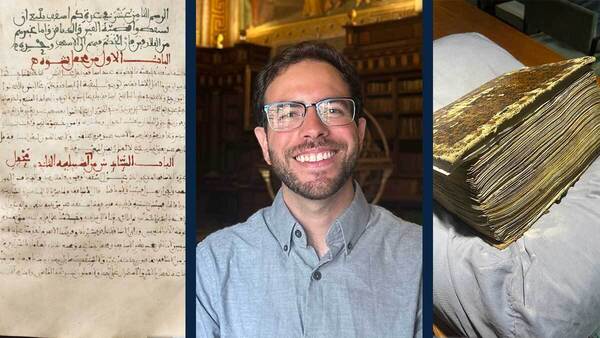
The Medieval Institute is delighted to announce that Ph.D. Candidate Francisco J. Cintrón Mattei has been awarded the prestigious Millicent Mercer Johnsen Rome Prize. Congratulations, Francisco!
We asked Francisco to share more with our community about his project and what the Rome Prize will mean for it.
"My Rome Prize project supports the completion of my dissertation, 'The Christian Imamate of Al-Andalus: Law, Society, and Christian Community in the Islamic West.' My dissertation studies the Arabic Collectio Hispana from Muslim Spain & Portugal (Al-Andalus), the westernmost example of a canon law code translated into Arabic in the medieval Mediterranean. Surviving in a single manuscript housed in the Royal Library of the Monastery of San Lorenzo de El Escorial (Madrid, Spain), the Arabic Collectio Hispana is an unparalleled source for the social, cultural, and intellectual history of the Christian minority in Al-Andalus. My dissertation treats the code’s translated laws as novel sources of Christian-Arabic writing that reveal how Andalusi Christians adapted their laws and beliefs to the world of Islam.
"The Rome Prize grants me the unique opportunity to expand the horizons of my dissertation, from the shores of southern Spain to the eastern Mediterranean. My residency in Rome during the 2026–27 academic year will be devoted to the comparative study of Arabic translations of canon law codes produced by Eastern Christians, many of which are housed in the Biblioteca Apostolica Vaticana. In general, my work seeks to advance our knowledge of the societal changes brought on by the rise of Islam and how Christians from Iberia to Isfahan responded in their own Arabic laws and idioms. I contend that Arabic canon collections provide a rich lens into these developments. When read comparatively, these sources provide a greater sense of both the shared experiences and unique histories of the separate churches of the Islamic world. The Rome Prize allows me to better situate the Arabic Collectio Hispana within the broader genre of Christian-Arabic literature and to better integrate Andalusi Christians into the history of Christians under Muslim rule."
The full press release from the American Academy follows.
American Academy in Rome Announces the 2026-27 Rome Prize Winners & Italian Fellows
April 22, 2026
ROME, ITALY and NEW YORK, NY— The American Academy in Rome announced today the recipients of the 2026–27 Rome Prize and Italian Fellows Program, its fellowships awarded through a national competition that supports innovative work in various disciplines across the arts and humanities in thirteen disciplines. The Rome Prize provides artists and scholars with dedicated time, space, and a transdisciplinary community in which to advance their work within the city of Rome. The Italian Fellows Program brings Italian artists and scholars into this shared environment, where they develop their own projects alongside Rome Prize Fellows. The thirty-one Fellows will
reside and work at the Academy’s eleven-acre campus on the Janiculum Hill for periods ranging from five to ten months, beginning in September 2026.
“Coming from a wide range of disciplines and practices, the 2026-27 cohort is united by their commitment to intellectual generosity and to cross-disciplinary engagement," said Peter N. Miller, President and CEO of the American Academy in Rome. “The Rome Prize is a bedrock of the Academy's mission to support the most compelling minds in the arts and humanities from across the United States. We look forward to welcoming this cohort and to the questions, ideas, and discoveries that will shape their time in the Eternal City.”
“The American Academy in Rome has fostered creativity and intellectual rigor at the highest level for more than 130 years now. Each class of Fellows represents a special chapter in that history, yet together, they form a lineage that spans generations,” said Calvin Tsao, Chair of the Board of Trustees. “It’s a great privilege to welcome this year’s Rome Prize Winners who will carry forward a long tradition of artistic and scholarly excellence.”
Each year, Rome Prize winners are recognized at the Janet and Arthur Ross Rome Prize Ceremony, to be held this year on April 22 at 6:30 pm (ET) in the Frederick P. Rose Auditorium at the Cooper Union in New York City. The program is open to the public and will feature a Conversations/Conversazioni on the theme of “Conservation and the Brain,” supported by the Helen Frankenthaler Foundation and moderated by President and CEO Peter N. Miller. Speakers include Whitney Museum conservator Carol Mancusi-Ungaro (2022 Fellow), Daphna Shohamy, Director and CEO of Columbia University’s Zuckerman Institute, and New York-based visual artist Shahzia Sikander.
Throughout the 2026–27 fellowship year, Rome Prize winners will be joined by a group of invited Residents—accomplished artists and scholars who come to the Academy for residencies of one to three months. In this shared environment, Fellows and Residents engage in ongoing exchange, participate in public programs, and generate collaborations in Rome and throughout Italy, analyzing the relationships between past, present and future, fostering dialogue across disciplines, and supporting new approaches to creative and scholarly work.
Rome Prize winners are selected annually by independent juries composed of distinguished artists and scholars. This year’s competition drew 958 applicants from across the United States and U.S. citizens living abroad, with an acceptance rate of 3.03 percent.
The Academy supports thirteen disciplines: ancient studies, architecture, design, east-west intersections, historic preservation and conservation, landscape architecture, literature, medieval studies, modern Italian studies, musical composition, renaissance and early modern studies, and visual arts. As of 2025, environmental arts and humanities has been introduced as an additional field of study.
Italian Fellows are likewise selected through a national jury process. The disciplines represented this year are musical composition and modern Italian studies.
View a complete list of the 2026–27 Rome Prize and Italian Fellow Program winners, along with the juries who contributed to their selection.
About the Rome Prize
Since 1894 the American Academy in Rome has awarded highly competitive fellowships that support advanced independent work and research in the arts and humanities. This year, the Rome Prize goes to thirty-one artists and scholars, who each receive a stipend, private workspace, and room and board at the Academy’s eleven-acre campus on the Janiculum Hill in 2026–27.
As the core of the Academy’s residential community, Rome Prize winners experience an incredible opportunity to expand their artistic and scholarly pursuits, drawing on the erudition and experience of their colleagues and on the inestimable resources of Italy, Europe, and the Mediterranean.
Press Contacts
Madalenna Bonicelli
Press Officer
m.bonicelli.ext@aarome.org
Laura Cabezas
Communications Officer
l.cabezas@aarome.org